Assessment · Companies
Where are defense companies putting their cash as buybacks drop?
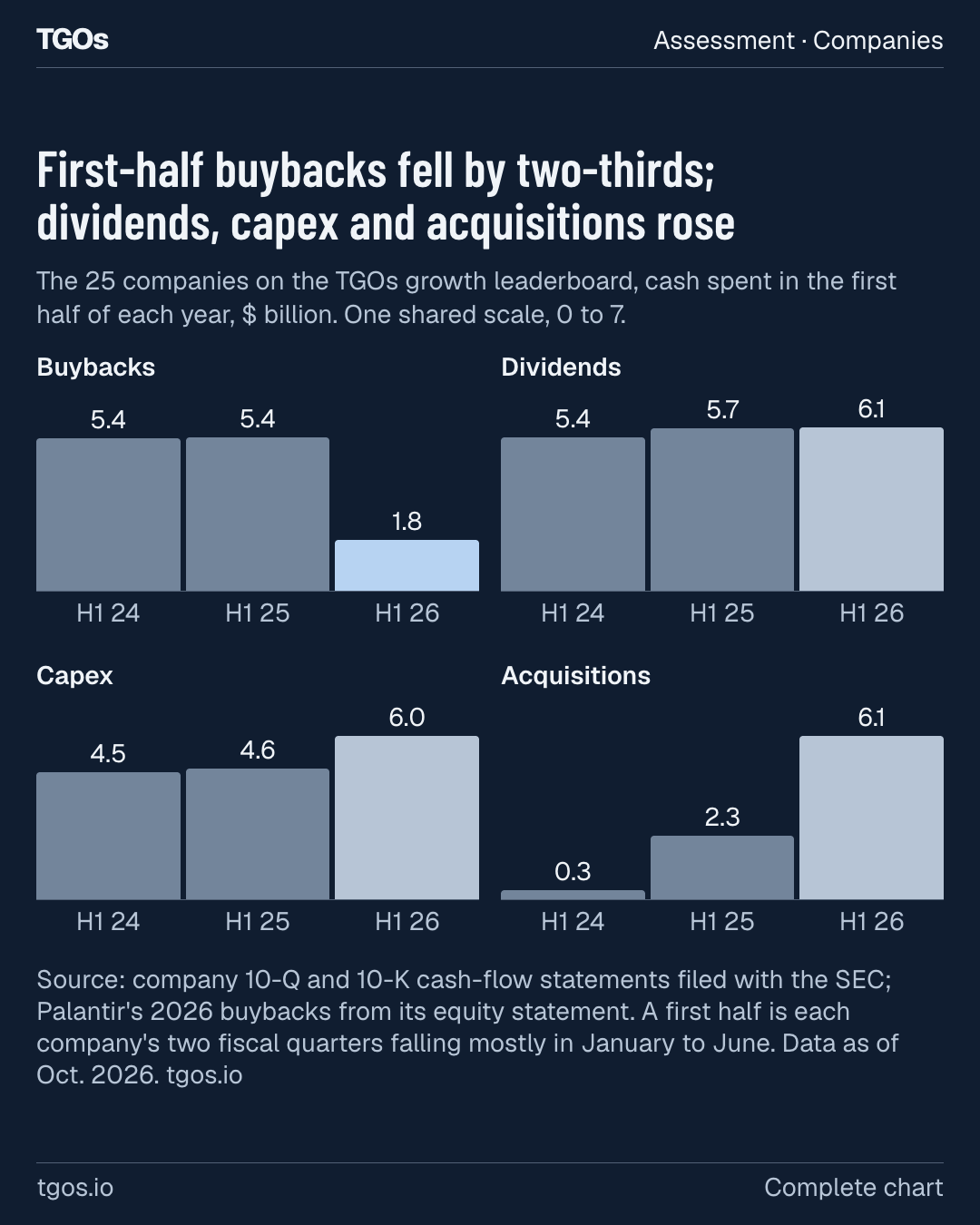
Into two $2 billion-plus deals, plant and dividends. Buybacks at the 25 companies on our growth leaderboard fell by two-thirds in the first half.
In this Assessment
The companies cut buybacks and kept paying dividends. The 25 companies on our growth leaderboard spent $1.8 billion buying back stock in the first half of 2026, against $5.4 billion in the same half of 2025.1 The leaderboard covers U.S.-based, U.S.-listed companies with at least $400 million in revenue whose annual report shows that most of their revenue is government work, mostly defense and intelligence. It adds Boeing, one of the Department of War's largest contractors; Palantir, with $1.9 billion of U.S. government revenue in 2025; and Parsons, which earns about half its revenue from federal work.2 Dividends rose 6%.1
On Jan. 7, President Trump signed Executive Order 14372. It says many large contractors that underperform "are not permitted in any way, shape, or form to pay dividends or buy back stock". It told the Secretary of War to make sure future contracts contain "a provision prohibiting both any stock buy-back and corporate distributions by the contractor during a period of underperformance".3 In March, Sens. Elizabeth Warren (D-Mass.) and Josh Hawley (R-Mo.) introduced a bill to require Department of War contractors "to prioritize meeting warfighter needs over the purchase of their own securities and executive compensation".4 The Senate Armed Services Committee's version of this year's defense bill, Booz Allen's quarterly report says, "includes a related provision".5 From June 15, 2027, its Section 815 would bar the department from signing a contract unless the contractor agrees in writing not to buy back its listed stock or pay dividends.6
Buybacks fell by two-thirds while the other three uses rose
First-half buybacks fell by two-thirds; dividends, capex and acquisitions rose
The 25 companies on the TGOs growth leaderboard, cash spent in the first half of each year, $ billion. One shared scale, 0 to 7.
Buybacks
Dividends
Capex
Acquisitions
Source: company 10-Q and 10-K cash-flow statements filed with the SEC; Palantir's 2026 buybacks from its equity statement. A first half is each company's two fiscal quarters falling mostly in January to June. Data as of Oct. 2026. tgos.io
The first and second quarters of 2026 were the two smallest of the 14 quarters for these companies' buybacks since the start of 2023. Before 2026, the smallest was the second quarter of 2025, at $1.6 billion, and the second quarter of 2026 came to $644 million. Full-year buybacks had already fallen in 2025, to $9.7 billion from $11.9 billion, but the first halves of those two years were level.1
Lockheed Martin accounts for about a third of the drop. Without it, buybacks still fell by more than half.1 Lockheed's quarterly report says that in the first six months "we did not make any repurchase of our common stock".7
Twelve of the 15 companies that bought back stock bought less
Twelve of the 15 companies that bought back stock bought less; three bought none
Share repurchases, first half of 2025 and of 2026, $ million. The companies that bought back stock in either half.
Source: company 10-Q and 10-K cash-flow statements filed with the SEC; Palantir's 2026 figure from its equity statement. Leidos and SAIC report shares withheld for taxes in the same line; Booz Allen's line may include them. RTX's last buyback was in the first quarter of 2025. Data as of Oct. 2026. tgos.io
Three bought none: BWX Technologies, Lockheed Martin and RTX.1 Palantir's fell to $1.5 million from $37 million.1, 8 Northrop Grumman bought $68 million, all in the first quarter.1 Its report says "We had no repurchases of common stock during the three months ended June 30, 2026".9 General Dynamics bought $319 million, which it says was "to cover dilution".1, 10 RTX had stopped before the order: its last buyback was in the first quarter of 2025.1
Neither Lockheed's report nor Northrop's says why.7, 9 Lockheed's report lists among the factors that could affect its results "capitalization changes such as share repurchases, dividend payments and financing transactions, including as a result of presidential executive orders".7 RTX says: "We are monitoring how these executive orders and related actions will be implemented and any potential future impacts to our business".11 Booz Allen, whose buybacks fell to $149 million, says that if it is identified under the order "it may have a negative impact on our dividends, stock buyback programs".1, 5
L3Harris kept buying, $525 million against $822 million.1 On its July 29 call, BNP Paribas analyst Matthew Akers asked about its appetite to keep buying "given kind of some of the political pressure we've seen on it". Chief Financial Officer Kenneth Sharp said "our first focus is investing in the business" and added: "And then share repurchases, I also think are something really important to consider".12 Leonardo DRS, Parsons and SAIC bought more.1
Dividends rose at 12 of the 14 payers
Dividend cash rose at 12 of the 14 companies that pay a common dividend.1 Northrop, which bought back no stock in the second quarter, raised its quarterly dividend 7% in May.9 The order and Section 815 both name dividends alongside buybacks.3, 6
CACI and Leidos account for most acquisition spending
Cash paid for acquisitions rose to $6.1 billion, from $2.3 billion.1 CACI and Leidos, which closed their purchases of ARKA and ENTRUST in March, paid $5.0 billion of it.1, 13 ENTRUST provides "infrastructure design, grid modernization and program management services primarily to electric, gas and pipeline utilities".14 Without those two companies, acquisition spending fell by more than a third, to $1.1 billion from $1.8 billion.1
Our deal tracker lists 12 acquisitions these companies announced after the order. The largest, still pending, is Lockheed's $3.45 billion purchase of Ultra Maritime.13, 15
Capex rose 31%, most of it at Boeing
Boeing, which says 35% of its 2025 revenue came from U.S. government contracts, accounts for $907 million of the $1.4 billion increase.1, 16 Without Boeing, capex rose 14%.1
Cash from operations nearly tripled
Operating cash flow came to $19.7 billion, against $6.7 billion a year earlier. The four uses together rose $2.0 billion.1 Lockheed repaid $1.2 billion of notes as they came due in the first half, against $142 million a year earlier.7 Sharp said that with the proceeds of selling a majority of its commercial space propulsion business, L3Harris expects "approximately $4 billion of cash on hand before any potential debt paydown or additional share repurchases".12
Section 815 still awaits Senate passage
The Secretary could waive Section 815 for contractors that agree to "a qualifying defense investment plan" the Secretary approves, and the section would expire at the start of 2031.6 The Senate hasn't passed the bill: on July 14, a procedural vote to take it up failed, 50 to 46.17 Third-quarter reports, due from late October, will show whether the first half was a pause, and the final defense bill whether Section 815 survives.
How we built this
The 25 companies are those on our growth leaderboard: U.S.-based companies listed on a U.S. exchange with at least $400 million in revenue in their latest fiscal year, whose annual report shows that most of their revenue is government work, done directly or through other contractors, and that most of that work is defense and intelligence. We add three companies central to defense whose reports don't show that: Boeing, one of the Department of War's largest contractors; Palantir, with $1.9 billion of U.S. government revenue in 2025; and Parsons, which earns about half its revenue from federal work.2 Cash figures come from the cash-flow statement in each company's 10-Q and 10-K reports filed with the SEC, as first reported. Palantir's 2026 cash-flow statements fold buybacks into other financing activities, so its figures come from its statement of stockholders' equity. Buybacks are repurchases of common stock; shares withheld for employee taxes are left out where a company reports them on a separate line. Leidos and SAIC report them together, and Booz Allen's line may include them. Dividends are cash dividends on common stock. Capex is purchases of property, plant and equipment. Acquisitions are cash paid for businesses, net of cash acquired. A first half is each company's two fiscal quarters that fall mostly in January through June, so SAIC's and AeroVironment's run from February through July.
Sources (17)
- Cash-flow statements in the 10-Q and 10-K reports of the 25 companies on the TGOs growth leaderboard (latest quarterly report linked); first halves as defined in the methods note: Amentum, AeroVironment, Boeing, Booz Allen, BWX Technologies, CACI, Curtiss-Wright, Ducommun, Leonardo DRS, General Dynamics, HII, KBR, Karman, Kratos, Leidos, L3Harris, Lockheed Martin, Mercury Systems, Northrop Grumman, National Presto, Palantir, Parsons, RTX, SAIC, V2X, growth leaderboard methods
- TGOs growth leaderboard, who's in it
- Executive Order 14372, Prioritizing the Warfighter in Defense Contracting (White House, Jan. 7, 2026)
- S. 4212, Prioritizing the Warfighter in Defense Contracting Act of 2026, as introduced
- Booz Allen 10-Q, quarter ended June 30, 2026
- S. 4784, National Defense Authorization Act for Fiscal Year 2027, as reported by the Senate Armed Services Committee
- Lockheed Martin 10-Q, quarter ended June 28, 2026
- Palantir 10-Q, quarter ended June 30, 2026: statement of stockholders' equity, repurchases of common stock in the six months, $1,500 thousand: Palantir 10-Q
- Northrop Grumman 10-Q, quarter ended June 30, 2026
- General Dynamics 10-Q, quarter ended July 5, 2026
- RTX 10-Q, quarter ended June 30, 2026
- L3Harris second-quarter 2026 earnings call transcript, July 29, 2026 (L3Harris investor relations)
- TGOs deal tracker: acquisitions the 25 companies announced since Jan. 7, 2026, and closing dates
- Leidos 10-Q, quarter ended July 3, 2026
- Advent International, sale of Ultra Maritime to Lockheed Martin
- Boeing 10-K for 2025
- S. 4784, all actions (Congress.gov)