Earnings analysis
Boeing's 2026 cash target counts on a tanker order
The target requires about $2.4 billion in fourth-quarter free cash flow. Slower production increases and rising inventory complicate the recovery.
In this analysis
Boeing is counting on a KC-46A tanker order and advance to help reach about $2 billion in free cash flow this year. 1, 2 With free cash flow still negative through September, the target puts the burden on the final quarter. 3, 2
The recovery depends on customer advances, higher aircraft deliveries and better production economics. 1 Those are moving at different speeds: commercial margins deteriorated from the second quarter, inventory consumed cash, and an asset-sale gain lifted defense earnings. 3, 4
On Boeing's October 27 earnings call, President and Chief Executive Officer Kelly Ortberg described the outlook as closer to a one-year delay relative to expectations. Responding to Citi analyst John Godyn, he said he did not think expectations for the slope or endpoint had changed. 1 Boeing projects approximately $10 billion of annual free cash flow in 2029. 2
The final quarter carries the cash target 3, 2
Boeing narrowed its full-year free cash flow estimate to about $2 billion. 1, 2 July's approximate range was $1 billion to $3 billion. 5 The implied final-quarter requirement is about 3.7 times second-quarter free cash flow, the strongest quarterly result of 2026 through September. 3, 4, 6, 2
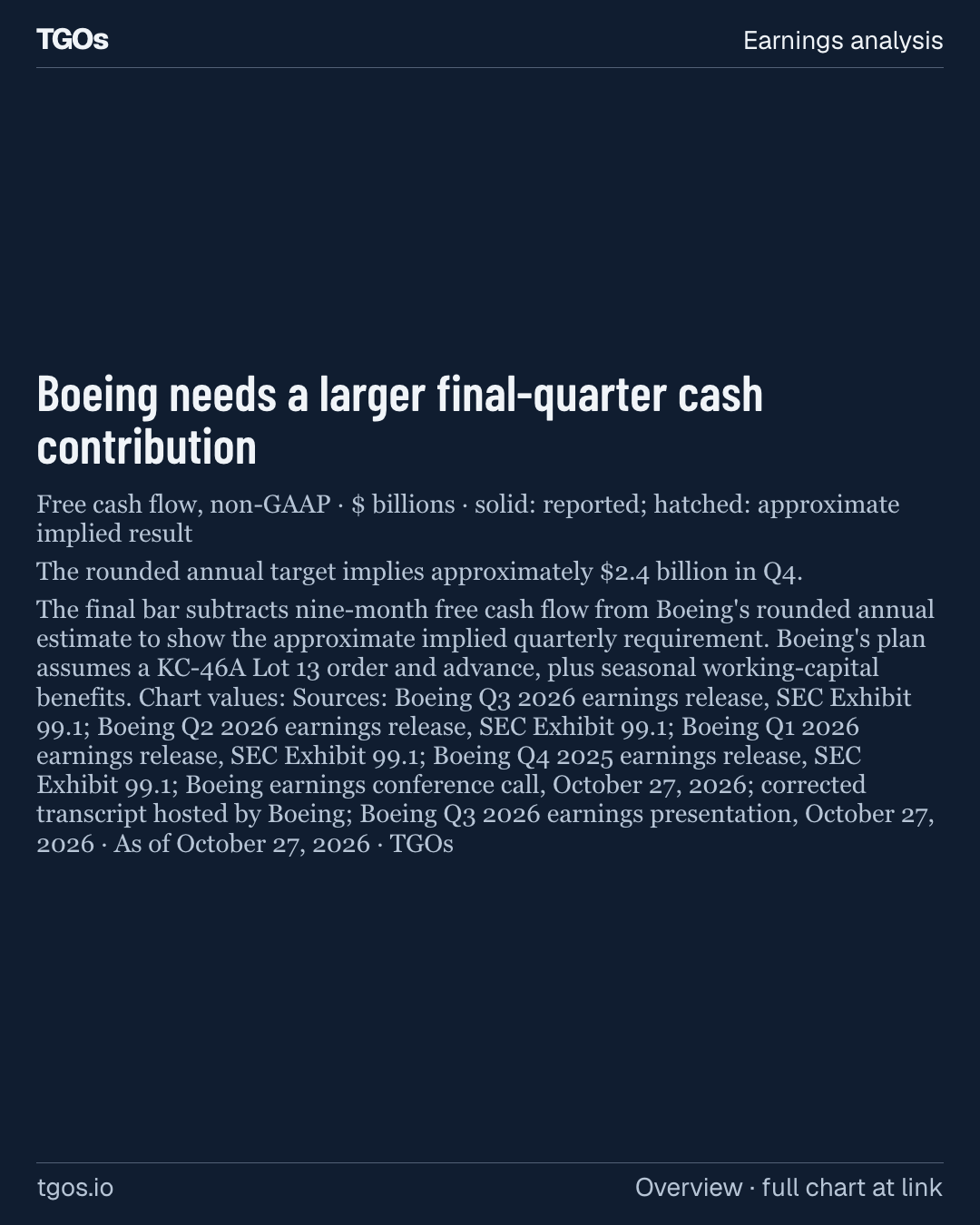
Boeing needs a larger final-quarter cash contribution
Free cash flow, non-GAAP · $ billions · solid: reported; hatched: approximate implied result
The rounded annual target implies approximately $2.4 billion in Q4. 3, 2
Executive Vice President and Chief Financial Officer Jesus (Jay) Malave identified the tanker assumption on the call. 1 At September 30, the Air Force had authorized 12 of the 13 priced annual production lots described in the filing. 8 The cash plan therefore includes a contract action beyond those authorized at quarter-end. 8, 1
Boeing carried about $113 million in capitalized precontract costs and $219 million in potential supplier termination liabilities for a future tanker production lot. 8
The annual estimates imply roughly $3.3 billion of fourth-quarter operating cash flow and about $1.0 billion of capital spending. These are approximate requirements derived from rounded annual estimates. 3, 2
Third-quarter operating cash flow was $1.5 billion. Boeing attributed the result to working-capital timing, partially offset by approximately $0.7 billion of Department of Justice settlement payments. 3 Capital spending primarily reflected higher investment at the Charleston and St. Louis sites. 3
The next cash increase includes a payment that disappears 1, 2
The annual free cash flow target rises by about $1 billion from 2026 to 2027. 2 In response to Wolfe Research analyst Myles Walton, Malave identified a $700 million benefit because the Justice Department payment will not repeat. Walton characterized the growth excluding that payment as a few hundred million dollars. 1
Malave expects higher commercial deliveries, modestly better cash margins on the 737 and 787, further defense improvement and continued services growth to support next year's cash flow. He expects lower commercial-aircraft order deposits, which he sized at a few billion dollars of impact, and higher capital spending to offset part of those gains. 1
Boeing projects a larger cash recovery after 2027
Approximate company estimates · $ billions · hatched: forecasts
Boeing expects capital spending to peak within this forecast period in 2027. 2
2026Operating cash flow ≈$6B
Capital spending ≈$4B · Free cash flow ≈$2B
2027Operating cash flow ≈$8B
Capital spending ≈$5B · Free cash flow ≈$3B
2028Operating cash flow ≈$10B
Capital spending ≈$4B · Free cash flow ≈$6B
2029Operating cash flow ≈$14B
Capital spending ≈$4B · Free cash flow ≈$10B
Ortberg said the 2027 cash estimate includes additional capital spending for F/A-XX development. 1 The Navy selection is excluded from backlog pending completion of the source-selection and evaluation review process. 3 Responding to BofA analyst Ronald Epstein, Ortberg identified F-47 as cost-plus but did not disclose the F/A-XX contract type. 1
The later cash targets assume 737 deliveries in the mid-to-high 50s per month in 2029. They also assume about 12 monthly 787 deliveries that year. Boeing's nearer-term financial plan targets a 737 production rate of 52 per month in the second half of 2027. 1
Malave expects normalized capital spending of 3% to 4% of revenue. He expects cash taxes to begin in the early 2030s. 1
Production delays are affecting commercial margins 8
Commercial Airplanes revenue fell 3.4% from a year earlier. Deliveries edged up to 161 from 160. Boeing cited less favorable delivery mix in explaining the quarter's commercial results. 3
Commercial delivery mix changed
| Aircraft | Q3 2025 | Q3 2026 |
|---|---|---|
| 737 | 121 | 124 |
| 767 | 6 | 10 |
| 777 | 9 | 5 |
| 787 | 24 | 22 |
Boeing attributed the quarter's negative commercial margin to less favorable delivery mix, higher projected costs associated with future production-rate adjustments and higher estimated supply-chain costs. 3 The filing ties the rate-related margin pressure to the decision to delay planned production increases for the 737 and 787. 8 Malave said the changes flowed through estimates at completion and lowered booking rates. 1
Sequentially, the commercial operating loss widened by $375 million. 3, 4 That reversed the second quarter's margin improvement. 3, 4, 6
Commercial margins reversed the second-quarter improvement
| Reported operating margin | Q1 2026 | Q2 2026 | Q3 2026 |
|---|---|---|---|
| Commercial Airplanes | -6.1% | -2.7% | -6.5% |
| Defense, Space & Security | 3.1% | -0.2% | 6.2% |
| Global Services | 18.1% | 18.1% | 18.3% |
The year-earlier commercial margin of -48.3% included a 777X charge, making it a poor measure of recent operating progress. 3 Commercial margins were also negative in the fourth quarter of 2025, at -5.6%, including Spirit acquisition impacts. 7
Boeing now expects to stabilize 737 production at 47 aircraft per month next year. 8 Responding to Bernstein analyst Doug Harned, Ortberg identified wings as the current source of instability. Malave expects this year's 737 deliveries to fall short of the 500-aircraft target. 1
For the 787, the next increase beyond eight aircraft per month is planned to begin in December. 8 Malave expects deliveries near the lower end of the 90 to 100 full-year range. 1 Reaching that lower bound requires 28 deliveries in the fourth quarter, above the 22 delivered in the third. 3, 1
Boeing expects 777 factory operations, disrupted by a key supplier's parts shortages that began in the third quarter, to remain disrupted through the first half of 2027. 8 Malave said shipments had resumed from the wing-component supplier whose disruption affected the freighter and tanker production lines. He expects abnormal costs to pressure commercial margins into the first half of next year. 1
Discussing commercial margins with JPMorgan analyst Seth Seifman, Malave said improvement later next year would put Boeing in a position to reach about breakeven in early 2028. 1
For 2027, Malave expects total commercial deliveries to rise 10% or more. The cash targets assume 777X certification by midyear. 1 The filing's expectation of approval for the final flight-test phases by the end of 2026 concerns a different milestone. 8 Ortberg said Boeing had financially provisioned for a certification delay to midyear within its estimate at completion, while working toward an earlier date. 1
Inventory absorbs cash as customer advances rise 3
Through September, advances and progress billings contributed $8.1 billion to operating cash flow, while inventory absorbed $6.7 billion. 3 Boeing attributed the advance-payment change primarily to Commercial Airplanes and Defense, Space & Security. 8 Customer funding is a counterweight to the inventory build, making the expected reduction in commercial deposits consequential for next year's cash outlook. 3, 1
Boeing aircraft inventory balances are rising
$ billions · paired balances at December 31, 2025 and September 30, 2026
777X work in process includes its deferred production costs. 8
Responding to TD Cowen analyst Gautam Khanna, Malave said deferred production balances for the 737 and 787 should start flattening next year. He expects those balances to become sources of cash in 2028 and 2029. He expects 777X deferred production balances to keep growing over the next few years. 1
Malave expects the 777X program to remain a substantial cash user next year. He expects its cash flow to improve in 2028 and turn positive in 2029. Certification and initial deliveries therefore precede the program's expected cash contribution. 1
The margin assumptions also differ by aircraft. Malave told Baird analyst Peter Arment that 737 margins would not regain 2018 levels, either in percentage or absolute terms. He expects 787 margins to exceed that historical level by 2029. 1
A sale gain lifts the defense margin 3
Defense, Space & Security revenue rose 15.0% from a year earlier. 3 Malave attributed about $160 million of quarterly sales to Spirit's acquired defense business. 1 Subtracting that contribution gives approximate growth of 12.6%; this calculation does not establish an organic growth rate. 3, 1
The filing identifies higher proprietary-program, weapons and tanker revenues, the Spirit acquisition and fewer unfavorable contract catch-up adjustments as drivers. The catch-up comparison alone added $310 million to year-over-year revenue. 8
The reported defense margin reached 6.2%, compared with 1.7% a year earlier. Boeing attributed the current margin primarily to the HRL Laboratories sale gain and improved operational performance. Removing the gain leaves $240 million of operating earnings and an approximately 3.0% margin, our calculation rather than a Boeing measure. 3
That result is close to the first quarter's 3.1% reported margin. 3, 6 Boeing's second-quarter margin excluding the VC-25B charge was 3.54%, a non-GAAP measure removing a different item. 5 These sequential comparisons show limited margin movement after those exclusions, though they are not a uniform adjusted series. 3, 6, 5
Defense's earnings improvement included $135 million less in net unfavorable contract catch-up adjustments than a year earlier. Charges remain relevant: Boeing increased the VC-25B reach-forward loss by $312 million through September. 8 The fourth quarter of 2025 included $0.6 billion of KC-46A losses. 7
Malave remains confident in reaching high-single-digit defense operating margins by the end of the decade. 1 Nearer term, the tanker has two roles in the recovery: an assumed order advance supporting cash and a production program affected by supplier shortages. 8, 1
Defense orders exceed recognized sales 3, 2
Defense orders were approximately $23 billion in the quarter, compared with $7 billion in the second quarter. 5, 2 That puts approximate quarterly book-to-bill at 2.9, using the rounded order value. 3, 2 Defense backlog rose by $15.2 billion during the quarter. 3, 4
Backlog growth spans different funding categories
| $ millions | June 30, 2026 | September 30, 2026 |
|---|---|---|
| Defense, Space & Security backlog | 85,322 | 100,505 |
| Company contractual backlog | 674,506 | 692,767 |
| Company unobligated backlog | 40,755 | 52,664 |
Companywide unobligated backlog increased by $11.9 billion in the quarter. 3, 4 Boeing attributes the nine-month increase in this category to defense awards, partially offset by reclassifications to contractual backlog. 8 That nine-month explanation does not establish the defense share of the quarterly companywide increase. 3, 4, 8
The quarter brought a contract for 22 more F-15EX aircraft for the U.S. Air Force. 1 Boeing received a seven-year contract award to expand PAC-3 Seeker production, following the framework agreement announced in the first quarter. 3, 6 For MQ-25, it received an undefinitized contract for 3 Lot 1 low-rate initial production aircraft. 8
The commercial business's three quarterly releases sum to 686 net orders through September. 3, 4, 6 Reported deliveries over those nine months totaled 475, including intercompany units. 3, 8 The filing records $3.2 billion of aircraft-order cancellations during the nine months. Those cancellations primarily involved the 737 and 787. 8
Services supplies the profit while commercial aircraft lose money 3
Global Services generated more operating earnings than Boeing's three segments combined because Commercial Airplanes and Defense, Space & Security together produced a loss. 3
Boeing services earnings exceed the combined segment total
Q3 2026 reported segment operating earnings · $ billions · before unallocated items
The defense result includes a $252 million sale gain. 3
Services revenue reached $5.6 billion, compared with $5.4 billion a year earlier. 3 On Boeing's non-GAAP comparison excluding the divested Digital Aviation Solutions business, revenue increased 11%. 2 Malave attributed that growth primarily to government and commercial modifications volume. 1
The services margin rose to 18.3%, from 17.5% a year earlier. 3 The second-quarter margin was 18.1%. 4 Those periods provide a steadier comparison than the fourth quarter of 2025, when the Digital Aviation Solutions sale gain distorted the reported margin. 7
Operating profit improves from a year-earlier loss; per-share results remain negative 3
Companywide revenue rose 3.9% from a year earlier, with defense and services growth offsetting weaker commercial revenue. 3 Revenue was below the second quarter, however. 3, 4
Boeing revenue rose year over year but eased sequentially
| Period | Revenue, $ millions |
|---|---|
| Q3 2025 | 23,270 |
| Q4 2025 | 23,948 |
| Q1 2026 | 22,217 |
| Q2 2026 | 24,560 |
| Q3 2026 | 24,188 |
GAAP operating earnings were $354 million, compared with a $4.781 billion loss a year earlier. Core operating earnings were $204 million, a non-GAAP result excluding the FAS/CAS service-cost adjustment. The GAAP diluted loss per share was $0.26, while the non-GAAP core loss per share was $0.34. 3
Unallocated items, eliminations and other reduced earnings by $610 million, versus $748 million a year earlier. 3 Malave cited lower corporate expenses as a contributor to improvement. 1 Quarterly interest and debt expense was $121 million lower than a year earlier. 3
Debt stood at $45.9 billion, down $8.2 billion from year-end but unchanged during the third quarter. 3, 8 Cash and marketable securities totaled $20.7 billion. 3
Boeing's next cash milestone depends partly on a tanker advance, while the larger recovery assumes more aircraft deliveries and less cash absorbed by commercial inventory. 1 The orders and services earnings are already visible; production stability and later cash conversion remain company expectations. 3, 8, 1, 2
Sources (8)
- Boeing earnings conference call, October 27, 2026; corrected transcript hosted by Boeing
- Boeing Q3 2026 earnings presentation, October 27, 2026
- Boeing Q3 2026 earnings release, SEC Exhibit 99.1
- Boeing Q2 2026 earnings release, SEC Exhibit 99.1
- Boeing Q2 2026 earnings presentation, July 28, 2026
- Boeing Q1 2026 earnings release, SEC Exhibit 99.1
- Boeing Q4 2025 earnings release, SEC Exhibit 99.1
- Boeing Form 10-Q, quarter ended September 30, 2026