Earnings analysis
Lower taxes drive most of Leidos’s non-GAAP profit growth
Lower tax expense explains most of the quarterly non-GAAP net income increase. Organic growth slows, and a smaller Corporate loss supplies nearly all the non-GAAP operating gain.
In this analysis
Leidos’s non-GAAP diluted earnings per share rose 18.7% to $3.62 in the third quarter. Pre-tax earnings grew more slowly: non-GAAP pre-tax income increased 2.3%, and the four segments’ combined non-GAAP operating income was almost unchanged.1
Lower tax expense supplied most of the net income increase, while fewer diluted shares amplified the per-share gain. Within operations, gains in Homeland and Intelligence & Digital largely offset a decline in Health. The smaller Corporate loss supplied nearly all the consolidated non-GAAP operating improvement.1
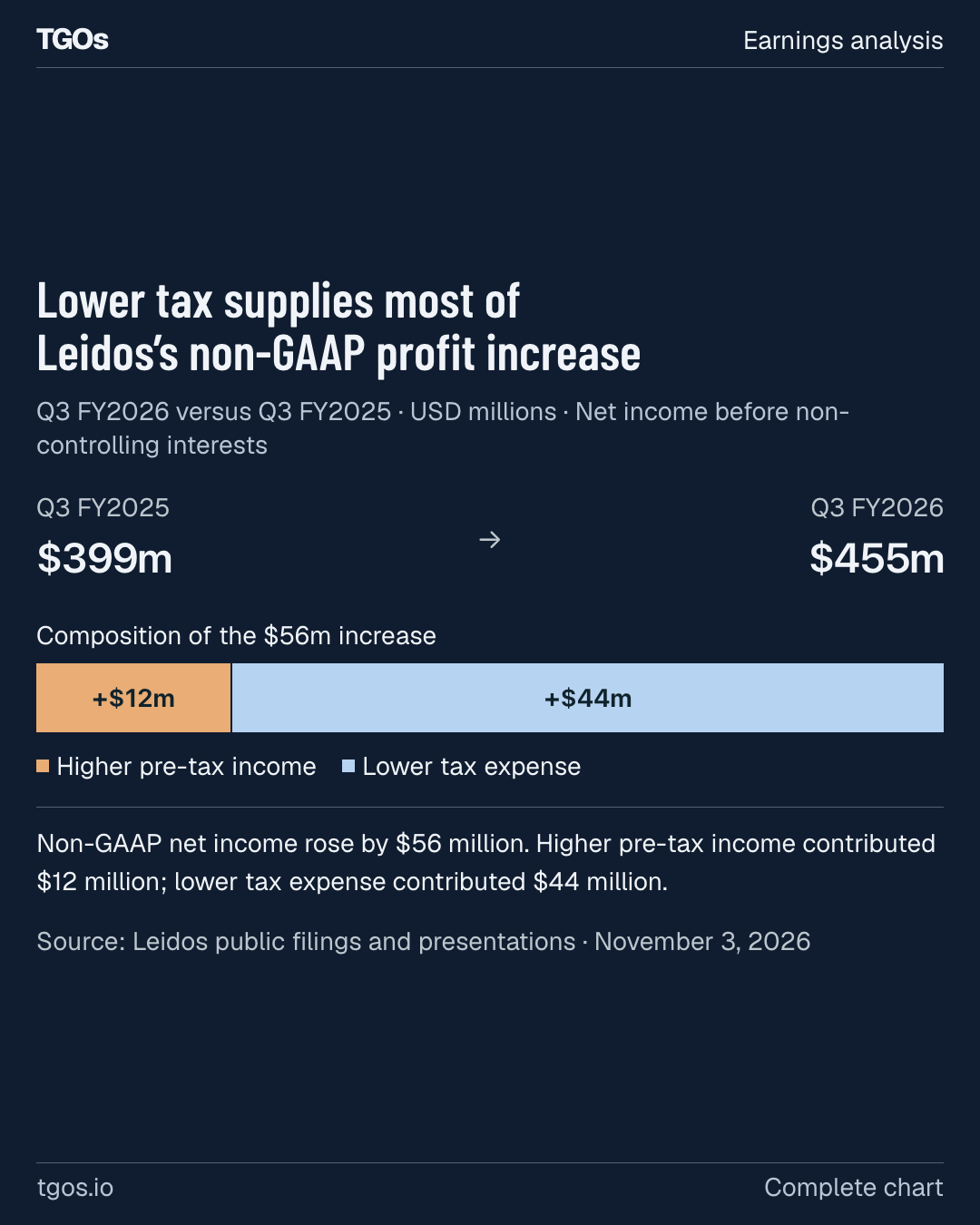
Lower tax supplies most of Leidos’s non-GAAP profit increase
Q3 FY2026 versus Q3 FY2025 · USD millions · Net income before non-controlling interests
Non-GAAP net income rose by $56 million. Higher pre-tax income contributed $12 million; lower tax expense contributed $44 million.1
The tax benefit outruns pre-tax growth
The lower tax expense accounts for 78.6% of the non-GAAP net income increase. Leidos attributes the lower effective tax rate primarily to a larger federal research tax credit and reduced unrecognized tax benefits.1 The company does not establish how much of the reduction will recur.
GAAP results show the same dependence on tax: pre-tax income slipped from $484 million to $482 million. Net income nevertheless rose by $44 million. GAAP diluted EPS increased to $3.28 from $2.82.1 Net favorable contract-estimate changes were $23 million versus $20 million, too small a shift to explain the earnings increase.1, 2
Our calculation puts the non-GAAP effective tax rate at 15.1%, down from 23.9% a year earlier.1 It also fell sequentially, from 21.8% in the first quarter and 20.7% in the second.1, 3, 4 Full-year guidance assumes a non-GAAP tax rate of about 20%, compared with the nine-month rate of 19.2%. The annual assumption is above the third-quarter rate but does not establish a specific fourth-quarter rate.1, 5
Non-GAAP net income attributable to common stockholders grew 13.9%, below EPS growth. Diluted shares fell to 125 million from 130 million. That is a decline of about 3.8% on the rounded counts.1
Corporate supplies the operating gain
The four segments together produced $634 million of non-GAAP operating income, compared with $633 million a year earlier. Corporate’s smaller loss therefore mattered more to consolidated profit growth than the net movement across the businesses.1
Corporate supplies nearly all of Leidos’s operating profit gain
Change in non-GAAP operating income · Q3 FY2026 versus Q3 FY2025 · USD millions
The four segments together added $1 million. Corporate added $31 million, taking the total increase to $32 million.1
On a GAAP basis, combined segment operating income fell 2.7%, while consolidated operating income rose by $18 million.1 Leidos attributes the smaller Corporate operating loss primarily to $23 million of lower legal expenses. The filing does not explain why the prior-year expenses were higher.2
Higher financing costs absorbed part of the operating improvement.1 Net interest expense rose by $16 million, which Leidos links to the senior notes issued in March.1, 2 Adjusted EBITDA grew 4.5%. Its margin was 13.9%, compared with 13.8% a year earlier.1
Acquisitions account for most of the revenue increase
Reported revenue reached $4.63 billion, but the net acquisition and divestiture effect supplied 83.9% of the year-over-year increase. Entrust contributed $142 million, while the organic comparison removes $7 million of divested revenue from the prior-year base. The resulting net transaction effect was $135 million; organic revenue added $26 million.1
Leidos’s organic growth slows in the third quarter
Year-over-year revenue growth · FY2026 quarters · Percent
Organic revenue excludes acquisitions within their first 12 months and removes divested revenue from the comparison base. The third-quarter acquisition contribution is Entrust.1
The slowdown in organic growth followed a stronger second quarter.1, 4 Leidos credits demand for defense technology, air traffic management and intelligence mission support, alongside Entrust, with offsetting declines in some managed health and federal civilian IT programs. Nine-month reported revenue grew 4.8%; the release does not provide a corresponding nine-month organic growth figure.1
Health’s profit decline deepens
Health remained the largest segment contributor to GAAP operating income, but its share fell to 41.5% from 54.5% a year earlier.1 Its quarterly profit declined both sequentially and year over year for a second consecutive quarter.1, 3, 4, 6
Leidos’s Health profit declines through the first three quarters
Health GAAP operating income · USD millions · FY2025 recast to the FY2026 segment structure
The year-over-year decline widens as FY2026 progresses.1, 3, 4, 6
Revenue fell 11.7% year over year to $1.068 billion. Leidos’s release attributes the revenue and margin declines to expected program shifts and lower managed health services volumes.1 The filing adds reduced incentive fees on those programs in the second half of fiscal 2026, without identifying the affected customer programs.2
Contract mix shows where some of the pressure sits: Health’s firm-fixed-price revenue declined, as did its revenue from other U.S. government agencies. Those categories do not identify the programs responsible for the reduced incentive fees.2
Homeland and Intelligence & Digital offset Health’s retreat
Homeland combined acquired scale with organic growth: revenue reached $1.024 billion from $0.775 billion. Organic growth was 14.8%.1 The filing credits higher volumes, program wins, Entrust and a $10 million favorable currency effect, partially offset by completed contracts.2 Leidos attributes improved profitability to a larger mix of higher-margin commercial work and cost management.1
Homeland’s GAAP operating income was $81 million, compared with $116 million on a non-GAAP basis. The reconciliation removes acquisition, integration and restructuring costs, acquired-intangible amortization and an impairment.1 The quarter still includes the SES business, so it is not a clean revenue baseline for the fourth quarter following the joint venture closing.1, 2
Intelligence & Digital generated $171 million of GAAP operating income, up 21.3%. Revenue rose from $1.525 billion to $1.546 billion. Leidos attributes the margin improvement to better program execution, including strong award-fee scores, and cost management.1
Its revenue explanations have different scopes.1, 2 The release cites recent contract awards, higher Intelligence Community volumes and expanded scope, offset by reductions in some federal civilian IT programs.1 The filing discusses the three- and nine-month periods together, citing program wins partially offset by a net volume decline and completed contracts.2 Neither document quantifies those opposing movements.1, 2
Defense accumulates backlog ahead of revenue
Defense’s total backlog rose 39.7% year over year, and its funded backlog increased 69.0%.1 Sequentially, total backlog rose from $12.59 billion in the first quarter to $13.76 billion in the second.3, 4 It reached $14.65 billion in the third quarter. That accumulation has yet to produce comparable revenue growth: Defense revenue was $992 million against $959 million a year earlier.1
Leidos’s backlog builds in Defense as Health and Intelligence & Digital shrink
Total backlog · USD millions · October 3, 2025 versus October 2, 2026
The October 2026 balances include Entrust and predate the SES closing. The filings do not disclose how much of Homeland’s backlog, if any, relates to SES.1, 2 Backlog does not establish when revenue will be recognized.
Leidos links Defense’s sales growth to demand for air defense, sensing and C5ISR systems.1 Nine-month operating income remained roughly flat, with program wins and better performance offset by completed higher-margin contracts.2 Earlier in the year, the company attributed lower first-quarter profitability to schedule delays on a fixed-price development program.3
Company-wide net bookings rose sequentially to $5.5 billion, but fell 6.8% from the prior-year quarter.1, 4, 2 Nine-month bookings increased 15.1%, providing a stronger year-to-date comparison.2 Total backlog grew 4.0% year over year, while funded backlog rose 22.0%. Funded work represented 22.3% of the total.1
The $21 billion of remaining performance obligations is a narrower measure than backlog. It excludes unexercised options and most task orders not yet awarded under indefinite-delivery, indefinite-quantity and similar contract vehicles. Leidos expects to recognize about 64% within 12 months. It expects to recognize about 83% within 24 months. Those estimates do not provide a conversion schedule for the larger backlog balance.2
Named awards show several different kinds of future work. Leidos received a $272 million award from Sierra Space for infrared sensing payloads, onboard signal processing and mission support, placing it in a supplier role. It also booked a $318 million, 12-month sole-source bridge to sustain and enhance MHS GENESIS. The bridge supports continuing work without establishing renewed growth.1
Leidos received a $27 million low-rate initial production award for 45 AGM-190A Havoc Spear missiles.1 The company’s November 2 release says initial Havoc Spear deliveries have begun.7 Deliveries under the 45-missile award are expected to start in fall 2027. That distinction separates an award from the production and deliveries still ahead.1, 7
Cash returns exceed quarterly free cash flow
Operating cash flow declined 26.4% year over year in the third quarter.1 Leidos attributes the decrease primarily to working-capital timing, including vendor payments, payroll and employee benefits.2 The nine-month comparison was stronger: operating cash flow rose 28.8% to $1.617 billion.1 The company credits favorable working capital and $148 million of lower tax payments.2
Quarterly cash falls while capital spending rises
USD millions · Actual Q3 results; free cash flow is non-GAAP
| Measure | FY2025 | FY2026 |
|---|---|---|
| Operating cash flow | 7111 | 5231 |
| Property, equipment and software payments | 311 | 471 |
| Free cash flow | 6801 | 4761 |
Free cash flow deducts property, equipment and software payments from operating cash flow.1
Leidos returned $556 million to shareholders in the third quarter, equivalent to 116.8% of non-GAAP free cash flow.1 Open-market buybacks totaled $500 million.2 The cash-flow statement’s broader repurchases-and-other line was $504 million; it includes items beyond open-market buybacks.1, 2 On October 30, the board raised the quarterly dividend to $0.45 per share.1
Capital spending also increased: nine-month payments for property, equipment and software rose 34.1% to $110 million.1 Quarter-end cash stood at $630 million, down from $748 million in July. Debt was $6.0 billion at both dates.1, 4 Debt was higher than at the start of the year following the March note issuance, while the Entrust acquisition used $2.338 billion net of acquired cash.1, 2 The disclosures do not trace the quarter’s buybacks to debt financing.
The SES venture changes the revenue comparison
Leidos closed the SES joint venture transaction on October 5, retaining a 41.5% non-controlling interest.2 Altaris affiliates have the right to appoint a majority of the venture’s board.8 Leidos will use equity-method accounting and include its share of the venture’s earnings in operating income. Fourth-quarter revenue will be lower than without the transaction.2
SES will not be presented as a discontinued operation, leaving prior periods with revenue from the business. That creates a comparison problem: reported revenue will lose SES sales while the earlier base still contains them.2 In April, Leidos projected $625 million of full-year 2026 revenue for the business it would contribute to the venture.9 That projection does not establish SES’s actual quarterly revenue, profit or backlog contribution.
Homeland’s October 2 backlog balance predates the closing; the filings do not disclose how much of it, if any, relates to SES. Leidos expects a preliminary non-operating gain of about $100 million in the fourth quarter, but has not stated its treatment in non-GAAP EPS guidance.1, 2
Guidance lowers revenue while raising EPS and cash
Leidos lowered both ends of its annual revenue range after adjusting for the venture and incorporating year-to-date performance and its outlook.1 August’s guidance had excluded the pending transaction.10 The company does not separate the SES effect from changes in the operating outlook, so the reduction cannot be assigned wholly to either.
Leidos’s annual guidance moves in different directions
FY2026 forecasts at each update · Revenue and operating cash flow in USD billions; non-GAAP diluted EPS in USD per share
| Update | Revenue | Non-GAAP EPS | Operating cash flow |
|---|---|---|---|
| February 17 | $17.50–$17.9011 | $12.05–$12.4511 | About $1.7511 |
| May 5 | $18.00–$18.403 | $12.10–$12.503 | About $1.803 |
| August 4 | $18.20–$18.404 | $12.20–$12.504 | About $1.854 |
| November 3 | $18.00–$18.201 | $12.50–$12.701 | About $1.901 |
Entrust closed on March 27, between the February and May updates.1 November incorporates the SES joint venture; August excluded the pending transaction.1, 10 These updates span changes in business scope.
Leidos raised its non-GAAP EPS range at each update, and the operating cash flow forecast rose again in November.1, 3, 4, 11 The adjusted EBITDA margin outlook remained in the mid-13% range.1 The official third-quarter presentation assumes a continuing resolution through 2026 and 126 million weighted-average diluted shares.5 The filing says federal funding is secured through December 11, making continued funding beyond that date an assumption of the outlook.2, 5
Subtracting nine-month revenue from annual guidance leaves approximately $4.41 billion to $4.61 billion for the fourth quarter, below the third quarter. This approximation comes from rounded annual guidance; Leidos has not issued a separate quarterly forecast.1 A prior-year comparison also mixes transaction effects with a quarter Leidos says was hurt by the six-week government shutdown.1, 2, 11
The same subtraction gives approximately $2.47 to $2.67 in fourth-quarter non-GAAP EPS.1 That is below the prior-year quarter’s $2.76.1, 11 EPS is not strictly additive across periods with different share counts, and the expected venture gain’s treatment remains unspecified.1, 3, 4, 2 Leidos provides no quarterly bridge that establishes the reasons for the implied step-down.
The annual cash forecast leaves approximately $283 million of fourth-quarter operating cash flow, versus $495 million a year earlier.1, 11 That remainder also follows the SES exit, so it does not describe cash generation on an unchanged business base.1, 2 The higher full-year earnings outlook therefore coexists with slower organic growth, weaker Health profit and a revenue base that changes again in the fourth quarter.1, 4, 2
This Assessment analyzes Leidos’s earnings releases, Form 10-Q and official presentation slides, supplemented by its recast segment figures, SES transaction disclosures and November 2 missile release. It does not incorporate webcast audio or analyst Q&A. Prior-year segment comparisons use the company’s recast four-segment structure. Non-GAAP measures retain Leidos’s definitions; calculated tax rates divide non-GAAP tax expense by non-GAAP pre-tax income.
Sources (11)
- Leidos Q3 FY2026 earnings release, November 3, 2026
- Leidos Q3 FY2026 Form 10-Q, quarter ended October 2, 2026
- Leidos Q1 FY2026 earnings release, May 5, 2026
- Leidos Q2 FY2026 earnings release, August 4, 2026
- Leidos Q3 FY2026 earnings presentation, November 3, 2026
- Leidos recast FY2025 segment supplement, February 17, 2026
- Leidos cruise missile production release, November 2, 2026
- Leidos Form 8-K, SES joint venture closing, October 5, 2026
- Leidos SES joint venture announcement, April 15, 2026
- Leidos Q2 FY2026 earnings presentation, August 4, 2026
- Leidos Q4 and FY2025 earnings release, February 17, 2026