Earnings analysis
Lockheed Martin’s higher outlook leans on missile production
Missile production supplies most of Lockheed’s quarterly segment-profit increase. F-35 funding remains unresolved as higher operating-cash expectations lift the full-year free-cash-flow outlook.
In this analysis
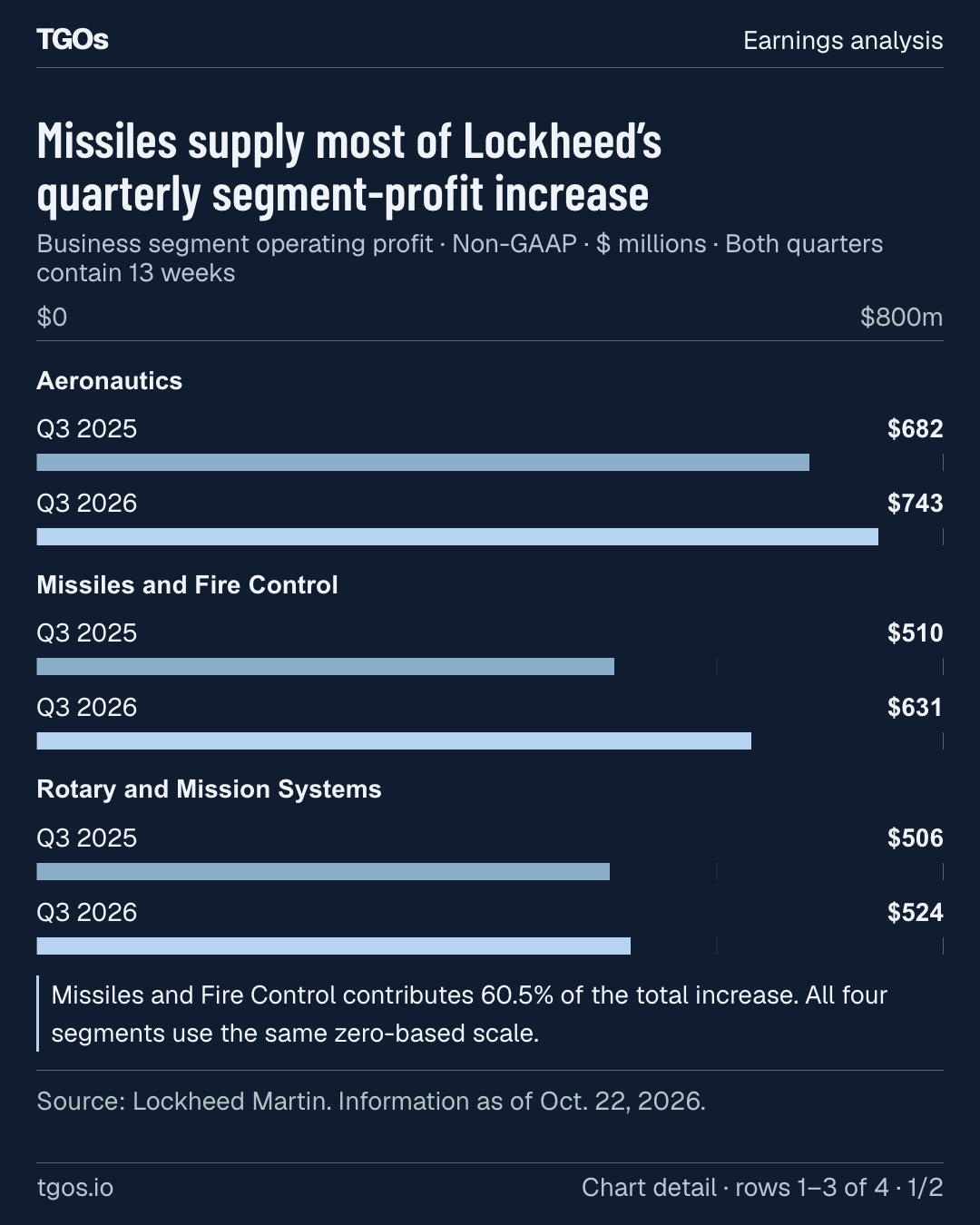
Lockheed Martin’s missile business is taking a larger role in its earnings, even as Aeronautics remains the bigger source of sales. Missiles and Fire Control supplied 60.5% of the third-quarter increase in business segment operating profit, helped by production ramps across air defense and strike missiles.1
That shift matters more than the modest increase in Lockheed’s total sales outlook. Missile sales and profit expectations rose while Aeronautics expectations fell. The company identified F-35 award timing among its full-year Aeronautics outlook drivers. It also warned that costs on the Lot 20 advance acquisition contract had begun exceeding authorization and funding.1,2
Companywide sales rose 11.3% to $20.71 billion, with growth in all four segments. Both third quarters contained 13 weeks, making this a cleaner period comparison than the shorter opening quarter or the longer final quarter of 2026.1
This Assessment analyzes the earnings releases, quarterly filing, official presentation, and PAC-3, THAAD and F-35 framework releases. Call remarks and analyst Q&A were not reviewed.
Missile volume adds profit without widening margins
Missiles and Fire Control (MFC) produced 41.7% of Lockheed’s quarterly sales increase from 21.7% of its sales. Its sales rose 24.2%, but the segment’s operating margin was essentially steady, at 14.0% against 14.1%.1
Lockheed attributed $480 million of MFC’s sales increase to PAC-3 and Terminal High Altitude Area Defense (THAAD) production ramps. Guided Multiple Launch Rocket System (GMLRS) and Precision Strike Missile (PrSM) ramps added $330 million. The company attributed the segment’s operating-profit increase primarily to higher volume.1
The sales ramp also continued sequentially: MFC added $400 million from the second quarter, with equal-length reporting periods. Its year-over-year growth accelerated from the second quarter to the third.1,3
| Year-over-year sales growth | Q1 | Q2 | Q3 |
|---|---|---|---|
| Lockheed Martin | 0.3% | 10.5% | 11.3% |
| Missiles and Fire Control | 8.2% | 19.5% | 24.2% |
| Aeronautics | -1.5% | 9.3% | 13.2% |
The company total and the two segments contributing most to Q3 sales growth are shown. Q1 2026 had 12 weeks against 13; Q2 and Q3 had 13 weeks in both years. Q1 growth is not calendar-normalized.1,3,4
The full-year missile outlook includes more than volume growth. Lockheed expects higher favorable profit adjustments as well as increased production.2 In the first nine months, higher net favorable adjustments on PAC-3 and THAAD contributed $75 million to MFC’s profit increase.5
Aircraft sales growth includes a contract-award catch-up
Aeronautics contributed more incremental sales dollars than MFC, but its 13.2% growth rate included previously incurred costs recognized with a contract award. C-130 sales increased by $270 million from liquidation of pre-contract costs incurred in anticipation of the third-quarter award.1
F-35 sales rose $710 million on higher production and sustainment volume. Deliveries nevertheless fell in both the quarter and the nine-month period. Higher sales therefore do not establish that more aircraft reached customers.1
| F-35 aircraft delivered | 2025 | 2026 |
|---|---|---|
| Third quarter | 46 | 43 |
| Nine months | 143 | 94 |
Production and sustainment sales are distinct from aircraft deliveries. The nine-month 2026 period contains one fewer reporting week.1
Aeronautics operating profit grew more slowly than sales, as higher unfavorable adjustments on F-16 and C-130 reduced the benefit of volume.1 For the nine-month period, Lockheed linked F-16 adjustments to production performance and development delays, and C-130 adjustments to diminishing manufacturing source integration challenges.5
| Segment | Sales, $m | Operating profit, $m | Operating margin |
|---|---|---|---|
| Aeronautics | 7,256 → 8,214 | 682 → 743 | 9.4% → 9.0% |
| Missiles and Fire Control | 3,624 → 4,501 | 510 → 631 | 14.1% → 14.0% |
| Rotary and Mission Systems | 4,373 → 4,511 | 506 → 524 | 11.6% → 11.6% |
| Space | 3,356 → 3,485 | 331 → 331 | 9.9% → 9.5% |
Q3 2025 → Q3 2026. All four reported business segments are included. Segment operating profit and margin are non-GAAP measures.1
Rotary and Mission Systems (RMS) benefited from higher radar volume. Its profit increase also included a favorable contracting-matter resolution, offset by unfavorable Heavy Lift and Seahawk adjustments. Government helicopter deliveries fell to 16 from 22 in the quarter.1
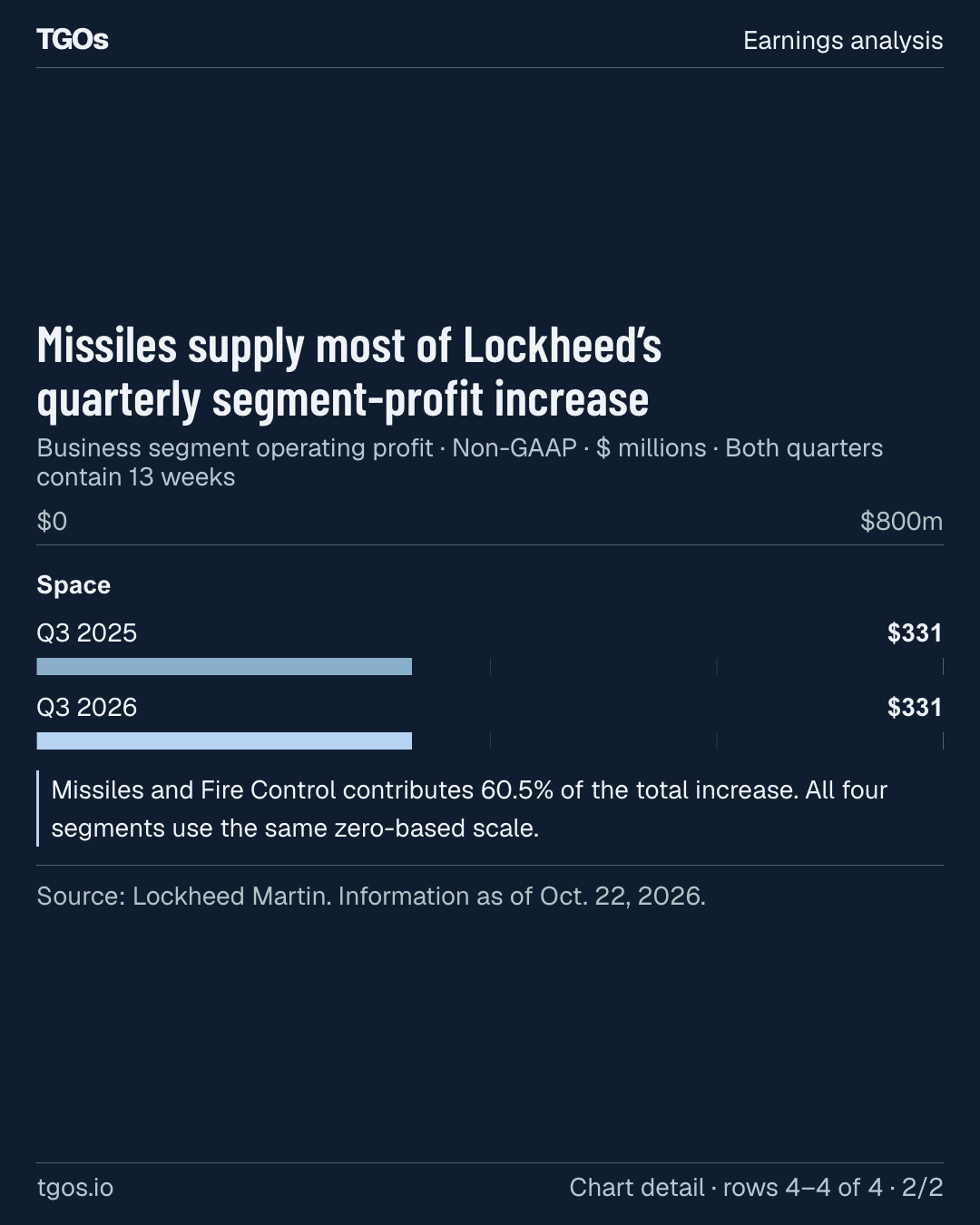
Space’s profit stayed flat despite sales growth. Higher strategic and missile defense sales, including Fleet Ballistic Missile and Next Generation Interceptor volume, were partly offset by lower national security space sales.1 Lockheed’s full-year Space outlook also assumes lower ULA equity earnings.2
Prior-year losses enlarge the year-to-date profit rebound
Nine-month business segment operating profit rose to $6.214 billion from $4.685 billion. The prior-year period included $1.615 billion of program losses.1 Their absence drives much of the Aeronautics and RMS rebound; the year-to-date increase should not be treated as a recurring operating improvement.5
Estimate changes still matter within the quarter. Net profit booking-rate adjustments represented 17% of segment operating profit, close to 18% a year earlier. Lockheed disclosed $394 million of remaining accrued losses on a classified Aeronautics program and $1.0 billion on a classified MFC program. The company warned that both programs may require further losses.5
Missiles supply most of Lockheed’s quarterly segment-profit increase
Business segment operating profit · Non-GAAP · $ millions · Both quarters contain 13 weeks
Missiles and Fire Control contributes 60.5% of the total increase. All four segments use the same zero-based scale.1
View the data
| Segment | Q3 2025, $m | Q3 2026, $m |
|---|---|---|
| Aeronautics | 682 | 743 |
| Missiles and Fire Control | 510 | 631 |
| Rotary and Mission Systems | 506 | 524 |
| Space | 331 | 331 |
The quarterly segment-profit increase of $200 million translated into a $163 million increase in GAAP consolidated operating profit. Net unallocated items contributed $214 million, down from $251 million. Other, net expense increased, while the pension operating adjustment grew.1
GAAP net earnings rose 14.0% to $1.845 billion, and diluted earnings per share rose to $7.97 from $6.95. Lockheed attributed the earnings increase primarily to higher consolidated operating profit. The effective tax rate also fell, primarily because of increased foreign-derived deduction eligible income deductions, partly offset by the absence of a prior-year favorable audit resolution.1
Missiles account for nearly all the backlog increase
MFC supplied 97.5% of Lockheed’s backlog increase since year-end.1 Its backlog rose sharply in the quarters containing the THAAD award and the PAC-3 MSE modification.1,3,4,6,7 Aeronautics backlog recovered during the third quarter but remained below its year-end level.1,3
Missiles approach half of Lockheed’s backlog
Reported segment backlog · $ billions · Common scale from zero
MFC’s share rises from 24.1% to 48.8%. Backlog represents remaining performance obligations, not cash received.1,5
View the data
| Date | Aeronautics, $m | MFC, $m | RMS, $m | Space, $m | Total, $m |
|---|---|---|---|---|---|
| Dec. 31, 2025 | 59,435 | 46,650 | 47,715 | 39,822 | 193,622 |
| Mar. 29, 2026 | 55,032 | 46,565 | 45,840 | 38,990 | 186,427 |
| June 28, 2026 | 54,356 | 87,882 | 48,454 | 39,724 | 230,416 |
| Sept. 27, 2026 | 57,331 | 142,517 | 49,435 | 42,701 | 291,984 |
Lockheed associates $52.5 billion of backlog with the PAC-3 Missile Segment Enhancement (MSE) award.1 Its separately announced seven-year modification was for up to $53.86 billion; those figures describe different measures and are not interchangeable.1,6 Neither the earnings release nor the 10-Q explains the difference between the modification amount and the backlog amount.1,5,6
The THAAD undefinitized contract action was for up to $35 billion over seven years.7 Neither award’s up-to value establishes how much funding the government has obligated or how much cash Lockheed has collected.6,7 Backlog itself includes estimates of consideration under contracts, which may exceed contractual award amounts for some contract types.5
The company reported a 4x quarterly book-to-bill ratio, defined as orders received divided by sales recorded.2 It expects about 23% of backlog to become revenue within 12 months, and about 40% cumulatively within 24 months.5 The larger order book therefore extends well beyond the current sales outlook.1,5
Lockheed says the PAC-3 funding enables it to triple capacity by the end of 2030. That is a planned production expansion; the award alone does not establish installed capacity or delivered interceptors.6
The higher sales outlook contains an Aeronautics reduction
Lockheed raised full-year sales guidance by $250 million at both ends, to approximately $80–82 billion.1 Underneath that increase, the segment ranges moved in different directions.2
Lockheed raises missile sales expectations and lowers Aeronautics
Full-year 2026 sales guidance · $ millions · July versus October forecasts
Dashed intervals show forecast ranges. All four reported segments use the same scale, starting at zero.
View the data
| Segment | July sales outlook, $m | October sales outlook, $m |
|---|---|---|
| Aeronautics | $31,700–32,700 | $31,100–32,500 |
| Missiles and Fire Control | $16,500–16,900 | $17,250–17,450 |
| Rotary and Mission Systems | $17,700–18,100 | $17,700–18,000 |
| Space | $13,850–14,050 | $13,950–14,050 |
Lockheed now forecasts MFC sales growth of 19–21% and operating-profit growth of 20–22% for 2026. The company’s stated Aeronautics sales-growth range is 3–7%, with F-35 sustainment volume and award timing among the drivers.2
Aeronautics’ operating-profit outlook also fell at both ends, while MFC’s rose. The total business segment profit range narrowed, with a higher low end and a lower high end.1,2 The presentation lists F-35 award timing as a full-year sales driver, but does not explain or quantify the Aeronautics reduction from July.2
The immediate F-35 exposure is more concrete than a forecast range. Costs on the Lot 20 advance acquisition contract began exceeding authorization and funding during the quarter.1 Lockheed warned that without additional authorization and funding, future results, cash flows and financial condition will be negatively affected. Neither the earnings release nor the 10-Q quantifies the excess costs.1,5
The October F-35 framework covers 850 U.S. aircraft over 10 years, alongside sustainment and international orders across Lots 21–30. A formal contract still depends on multiyear authority and associated appropriations, followed by finalized terms, pricing and schedules.8 The framework does not establish additional authorization or funding for the existing Lot 20 exposure.1,8
October’s cash raise comes from operations
Lockheed lifted its full-year free-cash-flow outlook by $800 million at both ends in October, alongside higher operating-cash expectations.1 That differs from July, when the free-cash-flow outlook rose as planned capital spending fell and the operating-cash range changed little.1,3,9
Lockheed’s cash-flow raises have different sources
Full-year 2026 forecasts · $ millions · Free cash flow is non-GAAP
July paired lower planned capital spending with higher free cash flow. October raised expected operating cash. Dashed intervals show forecast ranges.1,9
View the data
| Measure | January, $m | July, $m | October, $m |
|---|---|---|---|
| Cash from operations | $9,150–9,450 | $9,200–9,400 | $10,000–10,200 |
| Capital expenditures | $2,500–2,800 | $2,000–2,400 | $2,100–2,300 |
| Free cash flow | $6,500–6,800 | $7,000–7,200 | $7,800–8,000 |
Third-quarter free cash flow nevertheless fell by $348 million from a year earlier, to $2.999 billion. Lockheed attributed the decline primarily to higher customer receipts in the prior-year quarter. Over nine months, free cash flow rose to $5.625 billion from $4.152 billion.1
The company attributed the year-to-date operating-cash improvement primarily to higher customer receipts and lower tax payments reflecting tax legislation and Treasury guidance.5 Quarterly collections were uneven: the second quarter’s operating cash was far above the prior-year quarter, before the third-quarter decline.1,3
Working capital shows why sales growth and cash growth can diverge. Contract assets, or unbilled revenue, rose primarily because of F-35 and MFC tactical and strike missile programs.5 Receivables, payables and contract liabilities moved in the opposite direction on the cash-flow statement.1
| Selected working-capital line | Nine-month 2026 cash-flow effect, $m |
|---|---|
| Contract assets | -3,898 |
| Inventories | -463 |
| Receivables | +805 |
| Accounts payable | +1,488 |
| Contract liabilities | +1,204 |
Five of the seven changes in assets and liabilities lines are shown: receivables, contract assets, inventories, accounts payable and contract liabilities. Income taxes and Other, net are excluded. This is not a complete operating-cash reconciliation. Positive values supply cash; negative values use cash.1
The annual cash comparison also contains pension timing. Lockheed’s 2025 operating cash and free cash flow were after an $860 million pension contribution fulfilling its 2026 obligation.9 The 2026 outlook assumes no pension contribution, so its increase over 2025 is not solely a measure of stronger current operations.1,9,2
Cash rises with an acquisition still pending
Cash reached $5.960 billion at quarter-end, up from $4.121 billion at year-end. Lockheed paid dividends and repaid debt, but made no share repurchases in the first nine months.1 Neither the earnings release nor the 10-Q explains the repurchase pause. Lockheed continued paying dividends and announced another dividend increase.1,5
| Cash use, $ millions | Nine months 2025 | Nine months 2026 |
|---|---|---|
| Dividends paid | 2,332 | 2,408 |
| Share repurchases | 2,250 | 0 |
| Long-term debt repayments | 142 | 1,168 |
Disclosed dividends, repurchases and long-term debt repayments. These are selected cash uses, not a full financing cash-flow reconciliation.1
The pending Ultra Maritime acquisition would use $3.45 billion of cash on hand.5 At the time of the quarterly filing, Lockheed expected it to close in the fourth quarter and enter RMS. The outlook excludes proposed acquisitions until consummated.1,5
ULA creates a separate contingent exposure: Lockheed agreed to guarantee certain borrowings with maximum potential principal of $750 million. The filing says Vulcan Centaur performance challenges are hurting ULA’s financial condition, and Lockheed and Boeing expect to provide additional support. The guarantee amount is a potential payment obligation, not a loss already recognized.5
Capital spending is weighted toward the final quarter under the current outlook.1 Lockheed’s separate munitions-investment announcements give differing totals through 2030, so they do not provide a reconciled bridge to annual capital expenditures.1,6,7
The final quarter requires more sales and more capital spending
Subtracting nine-month results from the October outlook shows the remaining work. The resulting ranges are approximate, and the final quarter has an extra reporting week versus 2025.1
| Measure, $ millions | Q4 2025 actual · 13 weeks | Q4 2026 implied · 14 weeks |
|---|---|---|
| Total sales | 20,321 | ≈$21,205–23,205 |
| Aeronautics sales | 8,524 | ≈$7,821–9,221 |
| MFC sales | 4,020 | ≈$4,999–5,199 |
| Business segment operating profit (non-GAAP) | 2,058 | ≈$2,361–2,461 |
| Cash from operations | 3,219 | ≈$3,107–3,307 |
| Capital expenditures | 463 | ≈$832–1,032 |
| Free cash flow (non-GAAP) | 2,756 | ≈$2,175–2,375 |
Implied amounts equal full-year October guidance less nine-month actuals. They are approximate forecast-derived amounts, not separately issued quarterly guidance or like-for-like growth estimates. Aeronautics and MFC are shown because they drive the outlook changes.1,9,2 Q4 2025 operating cash and free cash flow were after an $860 million pension contribution fulfilling the 2026 obligation; the 2026 outlook assumes no pension contribution.9,2
MFC needs a further sales step-up from the third quarter to meet its annual outlook, with one more reporting week in the final quarter.1,2 Aeronautics’ range allows either a decline or an increase against the prior-year final quarter, despite the extra week.1,9,2
The cash outlook implies lower final-quarter free cash flow than a year earlier, alongside higher capital spending.1,9 That comparison is against Q4 2025 cash flows already reduced by the $860 million pension contribution, while the 2026 outlook assumes none.9,2 The operating-cash ranges therefore do not establish flat underlying cash generation.1,9,2
Lockheed identifies higher missile production volume across named programs. Converting that demand into cash still depends on payment and funding arrangements.1,5 The government has indicated it would consider progress payments as the baseline for fixed-price contract payment terms, rather than performance-based payments.5 For F-35 Lot 20, the immediate issue is obtaining authorization and funding for costs already being incurred.1
Basis and sources
Quarterly comparisons use the corresponding 2025 period. Nine-month 2026 results contain one fewer reporting week; the final quarter contains one more. Backlog comparisons use the reported balance-sheet dates.1,3,4 Sales, consolidated operating profit, net earnings, earnings per share and operating cash are GAAP measures. Business segment operating profit and margin, and free cash flow, are non-GAAP. Free cash flow is operating cash less capital expenditures. Forecasts retain the company’s approximate ranges; final-quarter amounts are subtraction-based estimates, not management’s quarterly guidance.1
Sources (9)
- Lockheed Martin, third-quarter 2026 financial results, Oct. 22, 2026
- Lockheed Martin, third-quarter 2026 earnings presentation, Oct. 22, 2026
- Lockheed Martin, second-quarter 2026 financial results, July 23, 2026
- Lockheed Martin, first-quarter 2026 financial results, April 23, 2026
- Lockheed Martin, Form 10-Q for the quarter ended Sept. 27, 2026
- Lockheed Martin, PAC-3 MSE production award, July 29, 2026
- Lockheed Martin, THAAD production award, June 24, 2026
- Lockheed Martin, F-35 production and sustainment framework, Oct. 22, 2026
- Lockheed Martin, fourth-quarter and full-year 2025 financial results, Jan. 29, 2026