Assessment · Budget and contracts
How much defense AI money has reached contractors so far?
Selected AI-related contracts recorded $1.2 billion in obligations, October 2025–June 2026. The $49.9 billion fiscal 2027 request for AI-named budget lines depends almost entirely on reconciliation.
In this Assessment
One Palantir order accounts for more than half the AI contract money in our count.1–2 Contract actions that name AI, or that the Department of War's Chief Digital and Artificial Intelligence Office (CDAO) paid for, came to $1.2 billion from October 2025 through June 2026. That is 57% more than in the same months a year earlier, while all contract money the department funded grew 20%.2 One Palantir task order for the Maven Smart System supplied $638 million.1 Without Palantir, AI contract money grew 4%.2
The Department of War asked for $49.9 billion for fiscal 2027 on the budget lines and mandatory items it labels AI. That is 66 times the $758 million enacted on those lines' AI items for fiscal 2026. All but $995 million of the request is mandatory money.3 The whole budget "assumes $350 billion for DoW will be enacted in a subsequent mandatory reconciliation bill".4 A reconciliation bill needs a budget resolution adopted by both chambers. The House adopted one, introduced by Rep. Jodey Arrington (R-Texas), on July 22, and it has been on the Senate calendar since July 23.5 A Senate resolution introduced by Sen. Ron Johnson (R-Wis.) has been on the calendar since Aug. 7.6
Most of the AI request is for computing infrastructure
The largest piece is the $46.0 billion "sovereign AI Arsenal".4 The justification for its biggest piece lists the "procurement and installation of the initial fleet of state-of-the-art GPUs and AI supercomputers" and hardened, secure data centers at several sites.7 The current model of "fragmented, disconnected Graphics Processing Unit (GPU) clusters procured on an ad hoc basis" is "operationally inefficient and fiscally unsustainable", the department says.8
The $49.9 billion request puts computing infrastructure first:
| Item, in the department's words | Kind | FY2027 request |
|---|---|---|
| AI Arsenal: Artificial Intelligence Arsenal Strategy Development (OSD) | Procurement, mandatory | $29.5 billion7–8 |
| AI Arsenal: Sovereign Artificial Intelligence (AI) Infrastructure, DISA | Operations, mandatory | $12.3 billion8 |
| AI Arsenal: Sovereign Artificial Intelligence (AI) Infrastructure, DISA | Procurement, mandatory | $4.2 billion8 |
| Artificial Intelligence (AI)-Enabled Deterrence | Research, mandatory | $2.4 billion8 |
| Alpha-1 Development Activities (CDAO), with $0.5 billion for AI Pace Setting Projects | Research, mostly discretionary | $1.5 billion8–9 |
| Undersea AI/ML; CDAO Dem/Val Activities | Research, discretionary | $25 million3 |
| Total | $49.9 billion |
Our budget tracker's market for AI, software and data shows $38.9 billion for the same request, $11.0 billion less.3 Because it counts only research and procurement lines, it leaves out the $12.3 billion of DISA operations money. It also adds $1.3 billion for lines that don't name AI, mostly software pilots and digital and data offices. Those lines are why it shows $1.5 billion for fiscal 2026, against our $758 million.3
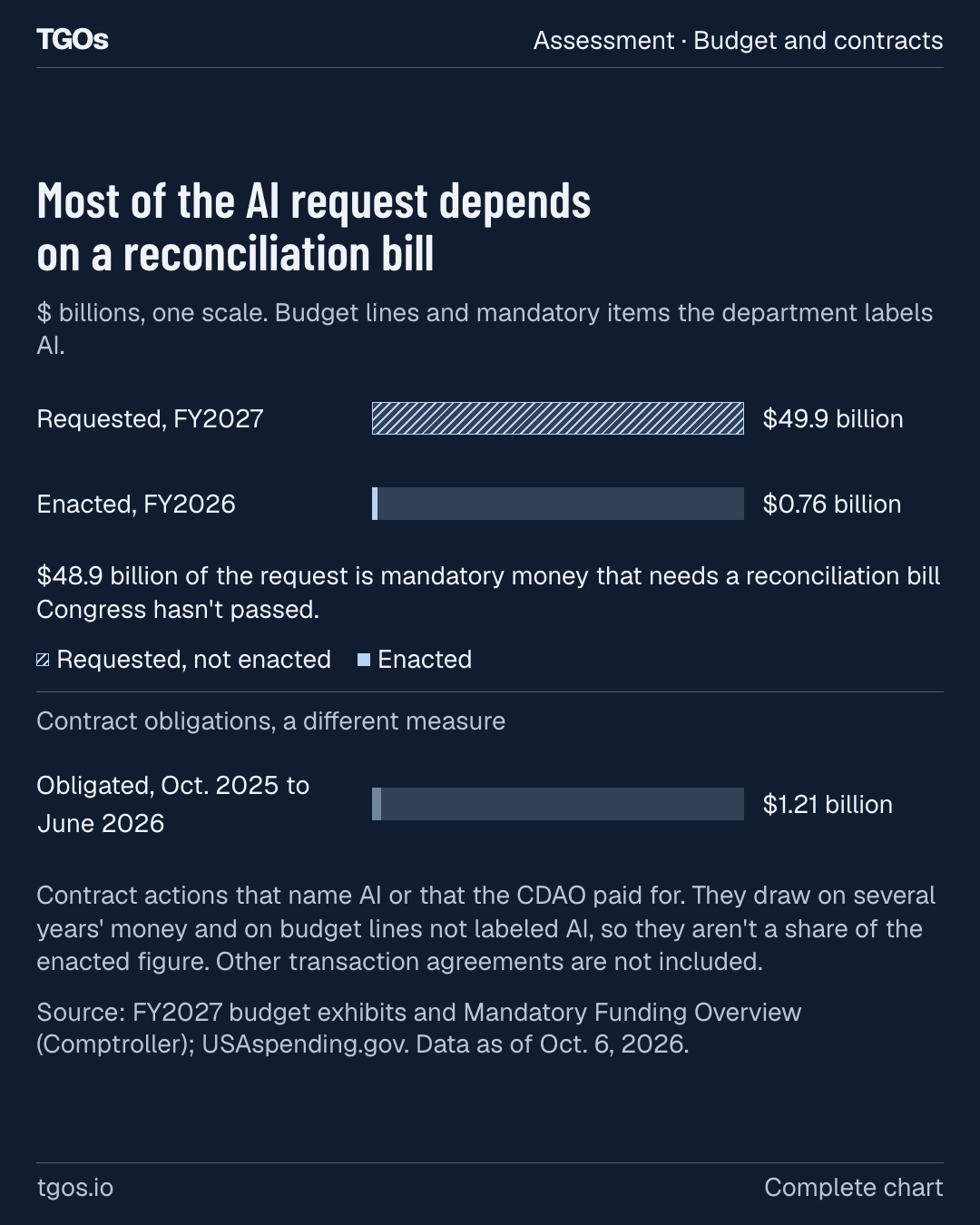
Most of the AI request depends on a reconciliation bill
$ billions, one scale. Budget lines and mandatory items the department labels AI.
$48.9 billion of the request is mandatory money that needs a reconciliation bill Congress hasn't passed.
- Requested, not enacted
- Enacted
Contract obligations, a different measure
Contract actions that name AI or that the CDAO paid for. They draw on several years' money and on budget lines not labeled AI, so they aren't a share of the enacted figure. Other transaction agreements are not included.
Source: FY2027 budget exhibits and Mandatory Funding Overview (Comptroller); USAspending.gov. Data as of Oct. 6, 2026.
Without a reconciliation bill, the request for the same lines is $995 million, 31% above what they got in fiscal 2026 counting last year's reconciliation money.3
The department's own figure, $58.5 billion, covers AI and Combined Joint All-Domain Command and Control. It includes $6.8 billion to build AI into platforms and workflows and $2.3 billion for the Maven Smart System and the Joint Fires Network.4 The budget overview doesn't tie either to budget lines.
One Palantir order is more than half of the AI money on contract
We count a contract action as AI money in two cases. In the first, the department funded it and its own description, or its award's, names artificial intelligence, Project Maven, the Maven Smart System or the CDAO. Related terms count too: machine learning, AI/ML, deep learning, neural networks, computer vision, large language models or LLMs, generative AI or GenAI, agentic, AI-enabled, AI-powered, AI-based, AI-driven, and AI platforms, tools, capabilities or models. In the second, the CDAO paid for it, including support work.
By that count, the department obligated $651 million to Palantir from October 2025 through June 2026, 54% of the total.2 Almost all of it was on one task order for the Maven Smart System.1 The order sits under the Army's $10 billion enterprise agreement with Palantir, awarded July 31, 2025.10 Army offices funded $411 million of the order and the CDAO $227 million.1
More than half of the AI contract money was obligated to Palantir
Obligations on contract actions that name AI or that the CDAO paid for, Oct. 2025 to June 2026, $1.21B in all, by parent as USAspending lists it.
- Palantir $651M 54%
- Amazon Web Services $54M 4%
- Groundswell $49M 4%
- HII (Enlighten IT) $42M 3%
- ASGN (ECS Federal) $34M 3%
- All others $385M 32%
$638M of Palantir's was obligated on one Maven Smart System task order.
Source: USAspending.gov contract transactions; HII and ASGN SEC filings for their subsidiaries. Data as of Oct. 6, 2026.
Behind Palantir, the largest recipients were Amazon Web Services, for the Advana data platform the CDAO paid for, and Groundswell, for its Agentic Auditor software.2, 11 Next came HII, through its Enlighten IT Consulting subsidiary, and ASGN, through ECS Federal.2, 12–13
Agent Network, one of the department's AI pace-setting projects, "builds on foundational Command and Control innovation by Palantir Technologies, which underpins the Department's Maven Smart System program, and Lumbra," the department said in June.14 Palantir's own results point the same way. Its revenue from U.S. government customers, all agencies, was $809 million in the quarter ended June 30, against $426 million a year earlier.15
The AI contract total is about 0.3% of the $383 billion the department obligated on contracts it funded in the same nine months.2
Each frontier AI deal was announced at $200 million, with $2 million obligated at award
In June and July 2025 the CDAO awarded prototype other transaction agreements to OpenAI Public Sector, Anthropic, Google Public Sector and AIQ Phase. Each had "a value of $200,000,000" and $1,999,998 obligated at award.16–17 Together, that is about $8 million obligated at award against $800 million in announced value.17 The department's daily contract announcements through Oct. 5, 2026, don't mention the four agreements again.18
Other transaction agreements don't reliably reach USAspending, where the contract totals above come from. GAO found in 2023 that "significant amounts of OTAs are likely not being reported to USAspending.gov".19 The four agreements are not in those totals. In May the department announced agreements with eight companies it calls frontier AI companies, to deploy their AI on its classified networks: SpaceX, OpenAI, Google, NVIDIA, Reflection, Microsoft, Amazon Web Services and Oracle.20 The release gave no dollar values.
The count misses AI inside bigger contracts
The contract count misses AI work that award descriptions don't name, AI built into larger programs, and classified awards. The department's $6.8 billion to build AI into platforms is that kind of money.4 So are big enterprise contracts. In March the Army announced a contract with Anduril "with a cumulative total of $20,000,000,000" that covers its "AI-enabled Lattice suite" along with hardware and services.21 The six orders under it in USAspending, $171 million in all, don't name AI, so the count leaves them out.22
The House plan caps the armed services changes at $60 billion of net deficit over 10 years
If a reconciliation bill funds the AI Arsenal, most of the AI request would go to computing infrastructure: GPUs, AI supercomputers and the data centers to house them.7–8 The House budget plan lets its Armed Services Committee make changes that add, net, "not more than $60,000,000,000" to the deficit over 10 years.23 The department asked for $350 billion in mandatory money for fiscal 2027 alone.4 The continuing resolution now funding the department runs through Dec. 11, 2026.24
Sources (24)
- USAspending.gov, award W9128Z26FA001 (task order under W519TC25D0039)
- USAspending.gov contract data
- FY2027 budget exhibits
- FY2027 Budget Request Overview Book
- Congress.gov, H.Con.Res.113
- Congress.gov, S.Con.Res.38
- Procurement, Defense-Wide justification, OSD, PB 2027
- FY2027 Mandatory Funding Overview
- RDT&E, Defense-Wide justification, OSW, PB 2027 (PE 0604133D8Z)
- War.gov contract announcements, Aug. 1, 2025
- War.gov contract announcements, June 9, 2026 (Army, W91CRB-26-F-A155)
- HII Form S-3ASR, Aug. 5, 2024
- ASGN Form 10-K for 2025, Exhibit 21.1 (subsidiaries)
- War.gov release, June 25, 2026: Agent Network
- Palantir Technologies 10-Q, quarter ended June 30, 2026
- War.gov contract announcements, June 16, 2025
- War.gov contract announcements, July 14, 2025
- War.gov daily contract announcements
- GAO-24-106214
- War.gov release, May 1, 2026: Classified Networks AI Agreements
- War.gov contract announcements, Mar. 13, 2026
- USAspending.gov, orders under contract W9128Z26DA001
- H.Con.Res.113 as agreed to by the House (engrossed text), Sec. 201(b)(2)
- P.L. 119-103, Sec. 106(3) (continuing resolution)