Assessment · Budget
Congressional panels protect the defense topline while reshuffling the programs
Among procurement and R&D cuts of at least $100 million, House appropriators and Senate authorizers mostly targeted new lines or requests at least double fiscal 2026 funding.
In this Assessment
Three committees have marked up the fiscal 2027 defense request line by line: House Appropriations, House Armed Services and Senate Armed Services. The Senate Appropriations Committee hasn't marked up its defense bill.1 The marks change only the discretionary request. The $350 billion requested as mandatory money depends on a separate reconciliation bill.2
None of the three cut the total. House appropriators wrote that "the Committee recommendation fully matches the President’s budget request".3 Both armed services committees changed the national defense total by zero.4–5
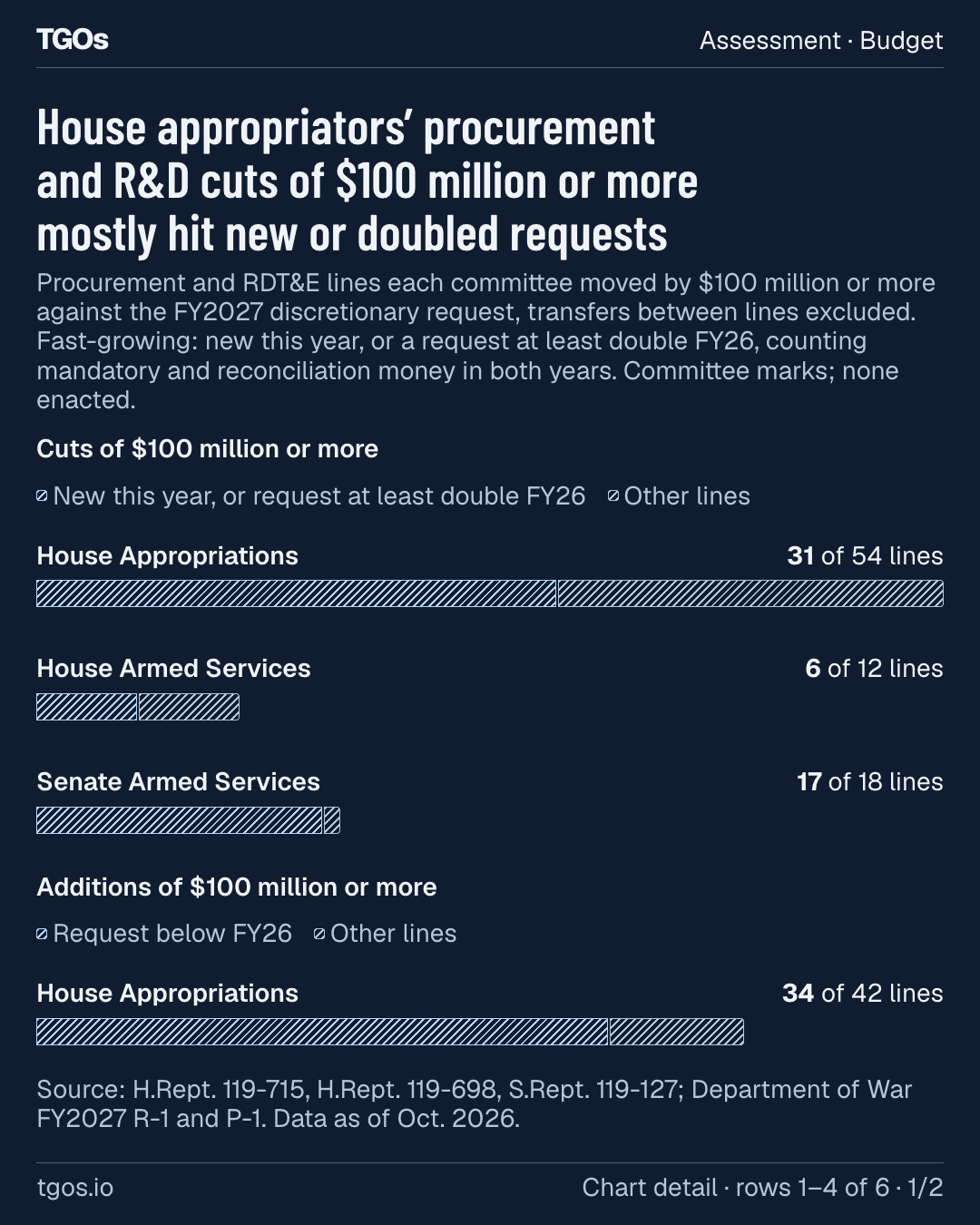
The fight is over which programs get the money. We compared each line's request with its fiscal 2026 money, counting mandatory and reconciliation money in both years.6 House appropriators cut 54 procurement and research lines by $100 million or more. Of those, 31 were new this year or asked for at least double their fiscal 2026 money.6
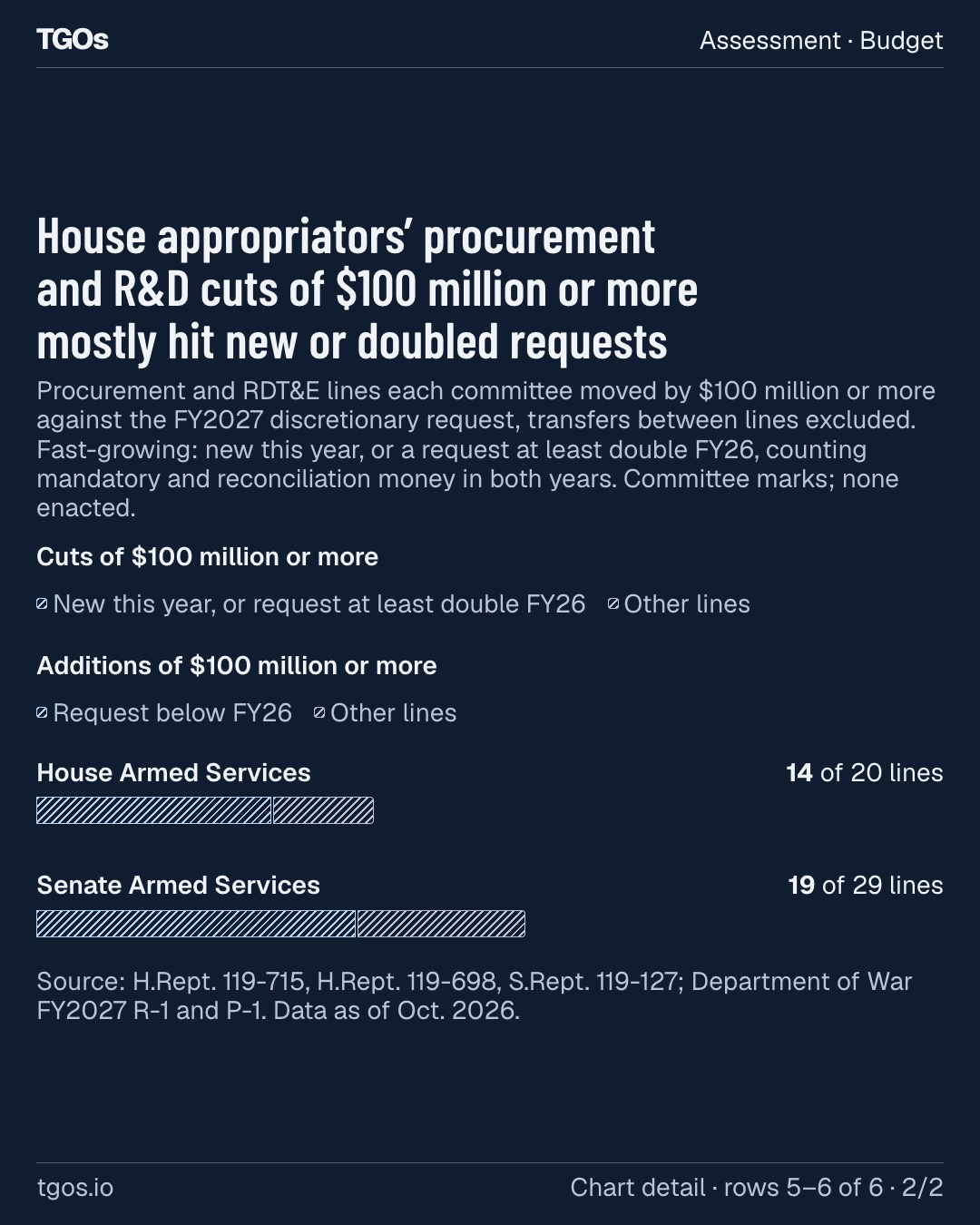
Senate authorizers' cuts of that size followed the same pattern, 17 of 18. House authorizers' split evenly, 6 of 12. House appropriators also added $100 million or more to 42 lines. Of those, 34 had asked for less than they got in fiscal 2026.6
House appropriators’ procurement and R&D cuts of $100 million or more mostly hit new or doubled requests
Procurement and RDT&E lines each committee moved by $100 million or more against the FY2027 discretionary request, transfers between lines excluded. Fast-growing: new this year, or a request at least double FY26, counting mandatory and reconciliation money in both years. Committee marks; none enacted.
Cuts of $100 million or more
Additions of $100 million or more
Source: H.Rept. 119-715, H.Rept. 119-698, S.Rept. 119-127; Department of War FY2027 R-1 and P-1. Data as of Oct. 2026.
All three committees cut AS(X) submarine tenders and Automate Sat C2
The request asked $4.4 billion for AS(X) submarine tenders, a new line.7 Senate authorizers cut $2.1 billion, with the note "Second ship early to need, unjustified savings".5 House appropriators cut $2.2 billion, a "Program adjustment" in their table.3 House authorizers cut $880 million, including a "Reduction for incremental funding of submarine tender contract".4
Automate Sat C2, a new Space Force line, asked for $1.5 billion.8 Senate authorizers cut $1.5 billion of it as "Unjustified growth".5 House appropriators cut $933 million and House authorizers $719 million.3–4
Command and control, space and AI lost money in all three bills
All three committees cut command and control, space and AI, and added to rotorcraft
Each committee's change to the FY2027 discretionary request for procurement and RDT&E in the 16 capability markets of the TGOs budget tracker, $ billions, values in legend order. Committee marks; none enacted.
Source: H.Rept. 119-715, H.Rept. 119-698, S.Rept. 119-127; Department of War FY2027 R-1 and P-1; markets as in the TGOs budget tracker. Data as of Oct. 2026.
In command, control and communications, House appropriators cut $2.1 billion, 12% of the request.9 Most of that came from the defense-wide JADC2 experimentation line, which asked $2.1 billion after $569 million in fiscal 2026. Reconciliation money was $275 million of that.10 House appropriators cut the line by $1.1 billion, calling the request for "Mission Command Applications" unjustified.3 Senate authorizers cut $650 million as "Unjustified growth for JADC2".5
The Army asked $2.9 billion for two command-and-control procurement lines, C2 Transport and C2 Infrastructure.11 The Army's budget justification names the fiscal 2026 lines the two replace, and says C2 Transport "is not a new start line".12 Those budget lines got about $1.8 billion in fiscal 2026.13 House appropriators split the two lines into six narrower lines for "proper budget execution" and trimmed them by $510 million, for items such as "C2NOW TEC Hardware early to need".3 House authorizers cut $820 million, listed as a "Program decrease".4 Senate authorizers left both lines at the request.5
In AI, House appropriators and Senate authorizers each cut $250 million from Alpha-1, a defense-wide AI development line.10 House appropriators cited a "Lack of government management oversight" and Senate authorizers "Unjustified growth for Alpha–1 activities".3, 5
House appropriators' own changes to procurement and research lines cut $24.3 billion and added $16.8 billion.14 They also cut military personnel by $1.0 billion and operation and maintenance by $2.5 billion. The bill puts $12.9 billion into general provisions the request didn't fund. The largest are $5.25 billion for compute infrastructure and $3.25 billion for a combatant command contingency fund.3
Their second-largest line cut took $2.2 billion of the P-8A Poseidon patrol plane's $4.2 billion request, mostly as "Excess to need".3
Where the request cut, the committees added
The request asked $39 million for UH-60M Black Hawks, after $913 million in fiscal 2026. For CH-47 Chinooks it asked $211 million, after $629 million.15 House appropriators added $493 million for "additional UH–60M aircraft" and $456 million for "additional CH–47F Block II aircraft".3 House authorizers added "6 additional aircraft" and "7 additional aircraft" to the same lines.4
The request also zeroed the E-7 Wedgetail, which got $1.1 billion in fiscal 2026.16 The Secretary of the Air Force and the Secretary of War testified that they had sent the White House budget office an amendment "to restore funding for the platform", the committee wrote. Its bill funds $1.5 billion, moved from other lines at the Department of War's request.3 Senate authorizers added $1.5 billion to "Restore full funding for E–7".5
All three put money back into Next-Gen OPIR Polar, missile-warning satellites the request zeroed after $437 million in fiscal 2026.8 House appropriators provided $200 million and House authorizers $415 million.3–4 Senate authorizers added $500 million to "Restore funding to Next Generation Polar".5
Discretionary money for munitions the request put in mandatory
The request sought $300 million of the Air Force's Family of Affordable Mass Missiles purchase as mandatory money and $55 million as discretionary.17 House appropriators provided "$355 million to procure Air Force’s Family of Affordable Mass Missile systems", part of $836 million "to procure, for the first time, new-entrant low-cost munition systems".18 Senate authorizers raised the line to $900 million, for "3,000 Family of Affordable Mass Missile (FAMM)".5 Rep. Ken Calvert, the California Republican who chairs the House Appropriations defense subcommittee, said the mandatory request held munitions money "which should have been built into the base discretionary request".19
The Senate panel added a destroyer and cut four other ship lines
Senate authorizers added $2.5 billion for a "Second DDG–51 ship for FY27". They cut $2.4 billion from carrier refueling overhauls, noting "Incremental funding extended". They zeroed the $1.0 billion BBG(X) battleship line as "Advance procurement early to need" and the $611 million T-AGOS surveillance ship line as "Third ship early to need".5 House authorizers added $1.0 billion for "Incremental funding for an additional DDG–51". Their bill would require the Secretary of the Navy to certify that the battleship's planned systems "are at a sufficiently mature technology readiness level" before a construction contract.4 House appropriators funded the battleship line as requested.3
The Senate appropriations mark is still to come
The table lists 33 lines. On each, at least two committees moved the request the same way by $100 million or more.6 Only AS(X) and Automate Sat C2 drew cuts that size from all three. The Senate Appropriations Committee's bill would be the fourth mark. A continuing resolution signed Sept. 2 (P.L. 119-103) funds the government through Dec. 11; our CR analysis covers what it blocks.20
The mandatory request is a separate fight. Calvert called reconciliation "uncertain and unaligned with the annual appropriations cycle, and outside the jurisdiction of this Committee".19 Rep. Betty McCollum, the Minnesota Democrat who is the subcommittee's ranking member, said it "is the wrong way to fund the Department of Defense".21
Lines two or three committees moved the same way by $100 million or more
| Line | FY26 enacted | FY27 request | House Appropriations | House Armed Services | Senate Armed Services |
|---|---|---|---|---|---|
| As Submarine TenderShipbuilding and Conversion, Navy | None | $4.4B | −$2.2B | −$880M | −$2.1B |
| Automate Sat C2Research, Development, Test, and Evaluation, Space Force | None | $1.5B | −$933M | −$719M | −$1.5B |
| CVN Refueling OverhaulsShipbuilding and Conversion, Navy | $2.1B | $4.4B | −$373M | 0 | −$2.4B |
| P-8A PoseidonAircraft Procurement, Navy | $14M | $4.2B | −$2.2B | 0 | −$128M |
| JADC2 Development and Experimentation ActivitiesResearch, Development, Test and Evaluation, Defense-Wide | $569M | $2.1B | −$1.1B | −$30M | −$650M |
| Test & Evaluation Science & TechnologyResearch, Development, Test and Evaluation, Defense-Wide | $1.7B | $3.8B | +$45M | −$254M | −$1.5B |
| Classified ProgramsResearch, Development, Test, and Evaluation, Space Force | $6.6B | $17.3B | −$923M | 0 | −$250M |
| Tagos Surtass ShipsShipbuilding and Conversion, Navy | $612M | $611M | −$234M | −$30M | −$611M |
| C2 INFRASTRUCTUREOther Procurement, Army | $784M* | $1.3B | −$359M | −$360M | 0 |
| Conventional Prompt StrikeWeapons Procurement, Navy | None | $750M | −$240M | 0 | −$375M |
| C2 TRANSPORTOther Procurement, Army | $1.0B* | $1.6B | −$151M | −$460M | 0 |
| Alpha-1 Development ActivitiesResearch, Development, Test and Evaluation, Defense-Wide | $646M | $1.0B | −$250M | −$40M | −$250M |
| KC-46A Tanker SquadronsResearch, Development, Test and Evaluation, Air Force | $130M | $544M | −$256M | −$228M | 0 |
| BMD Enabling ProgramsResearch, Development, Test and Evaluation, Defense-Wide | $600M | $1.5B | −$191M | −$277M | −$15M |
| Next-Gen OPIR -- PolarResearch, Development, Test, and Evaluation, Space Force | $437M | None | +$200M | +$415M | +$500M |
| Combating Terrorism Technology SupportResearch, Development, Test and Evaluation, Defense-Wide | $288M | $74M | +$170M | +$250M | +$200M |
| ARNG HMMWV Modernization ProgramOther Procurement, Army | $100M | None | +$100M | +$100M | +$140M |
| DDG-51Shipbuilding and Conversion, Navy | $5.6B | $3.0B | 0 | +$1.0B | +$2.5B |
| Family of Affordable Mass Missile (FAMM)Missile Procurement, Air Force | $335M | $55M | +$300M | 0 | +$845M |
| CH-47 HelicopterAircraft Procurement, Army | $629M | $211M | +$456M | +$381M | 0 |
| Paladin Integrated Management (PIM)Procurement of Weapons and Tracked Combat Vehicles, Army | $715M | $84M | +$577M | +$176M | 0 |
| UH-60 Blackhawk M Model (MYP)Aircraft Procurement, Army | $913M | $39M | +$493M | +$250M | 0 |
| Initial Spares/Repair PartsAircraft Procurement, Air Force | $1.2B | $1.4B | +$354M | +$300M | 0 |
| C-130JAircraft Procurement, Air Force | $1.5B | $637M | +$300M | +$280M | 0 |
| Trusted & Assured MicroelectronicsResearch, Development, Test and Evaluation, Defense-Wide | $549M | $157M | +$113M | +$2M | +$350M |
| Spares and Repair PartsAircraft Procurement, Navy | $2.8B | $4.5B | +$150M | +$300M | 0 |
| Nuclear-Armed Sea-Launched Cruise Missile (SLCM-N) SupportResearch, Development, Test and Evaluation, Navy | $1.7B | None | +$175M | +$250M | |
| Sonobuoys - All TypesOther Procurement, Navy | $370M | $300M | 0 | +$250M | +$100M |
| Warrior Systems <$5MProcurement, Defense-Wide | $500M | $511M | +$26M | +$124M | +$190M |
| ORDNANCE ITEMS <$5MProcurement, Defense-Wide | $114M | $237M | +$10M | +$144M | +$148M |
| MH-139AAircraft Procurement, Air Force | $278M | $253M | 0 | +$128M | +$128M |
| Improved Turbine Engine ProgramResearch, Development, Test and Evaluation, Army | $238M | None | +$155M | +$100M | 0 |
| Technology Maturation InitiativesResearch, Development, Test and Evaluation, Army | $354M | $315M | +$123M | −$10M | +$100M |
Each committee's own change to the FY2027 discretionary request, without transfers between lines. FY26 enacted includes reconciliation money. *FY26 on the lines it replaces, or on the same program on another line. A blank cell: the line isn't in that committee's table.
Sources (21)
- Senate Appropriations Committee, hearings and markups
- Congressional Research Service, FY2027 NDAA: Summary of Funding Authorizations (IN12703), July 24, 2026
- House Appropriations Committee, H.Rept. 119-715
- House Armed Services Committee, H.Rept. 119-698
- Senate Armed Services Committee, S.Rept. 119-127
- TGOs analysis of House Appropriations (H.Rept. 119-715), House Armed Services (H.Rept. 119-698), Senate Armed Services (S.Rept. 119-127); FY2027 R-1 and P-1. Lines a committee cut or raised by $100M or more with its own decreases or increases (amounts it labels transfers or realignments excluded). 'New or fast-growing': no FY26 money, or a whole FY27 request (discretionary + mandatory) at least double FY26 enacted including reconciliation money. 'Request fell': whole FY27 request below FY26 enacted
- Department of War FY2027 P-1 (Shipbuilding and Conversion, Navy)
- Department of War FY2027 R-1 (Research, Development, Test, and Evaluation, Space Force)
- TGOs analysis of House Appropriations (H.Rept. 119-715), House Armed Services (H.Rept. 119-698), Senate Armed Services (S.Rept. 119-127); FY2027 R-1 and P-1. Command, control and communications
- Department of War FY2027 R-1 (Research, Development, Test and Evaluation, Defense-Wide)
- Department of War FY2027 P-1 (Other Procurement, Army)
- U.S. Army, FY2027 budget justification, Other Procurement, Army, Budget Activity 2 (Communications and Electronics)
- TGOs analysis of House Appropriations (H.Rept. 119-715), House Armed Services (H.Rept. 119-698), Senate Armed Services (S.Rept. 119-127); FY2027 R-1 and P-1. FY26 enacted on the P-1 lines the Army justification names as predecessors: Tactical Network Communication, Satellite Communications and the decline in COTS Communications Equipment (C2 Transport); Army Command Post Integrated Infrastructure and Joint Battle Command-Platform (C2 Infrastructure). Named project codes that are not P-1 lines are not counted
- TGOs analysis of House Appropriations (H.Rept. 119-715), House Armed Services (H.Rept. 119-698), Senate Armed Services (S.Rept. 119-127); FY2027 R-1 and P-1. House Appropriations, every procurement and RDT&E line in its tables, including lines it created
- Department of War FY2027 P-1 (Aircraft Procurement, Army)
- Department of War FY2027 R-1 (Research, Development, Test and Evaluation, Air Force)
- Department of War FY2027 P-1 (Missile Procurement, Air Force)
- House Appropriations Committee, FY27 Defense Appropriations bill summary
- Rep. Ken Calvert (R-Calif.), chairman, House Appropriations defense subcommittee, remarks at the full committee markup, June 24, 2026
- Congressional Research Service, Overview of Continuing Appropriations for FY2027 (Division A of P.L. 119-103) (R49353)
- Rep. Betty McCollum (D-Minn.), ranking member, House Appropriations defense subcommittee, statement at the full committee markup, June 24, 2026